Mesh Wi-Fi, one router, or a wired access point: backhaul and installation decide it
Products that all claim whole-home coverage still differ in how they carry traffic between their own units, and that backhaul decides the result. The Wi-Fi Alliance describes Wi-Fi EasyMesh as multiple access points that work together to form a unified network, guide devices to the best AP and modify the network structure as conditions change, with the flexibility to add EasyMesh APs from multiple vendors. Manufacturer FAQs publish the limits alongside that. TP-Link's Deco FAQ (updated 17 April 2026) recommends up to six units per network on Wi-Fi or PLC backhaul, states that Ethernet backhaul has theoretically no unit limit, and adds plainly that "adding more Deco units does not always improve wireless throughput or stability. If there are no dead zones, additional units may not be necessary." Coverage figures carry conditions too: the Deco BE25 page headline advertises up to 6,600 square feet, and 2,600 square feet for a single unit, while noting that actual throughput, coverage and device counts are not guaranteed and vary with building materials, obstacles and traffic. This guide reads those conditions and shows how the answer changes when a cable is available.
Published · Updated · FaultNote editorial policy
Who this guide is for and what to prepare
- People with one slow or dropping room who cannot tell whether to buy a mesh system or simply replace the router
- People whose home has Ethernet in the walls, or could take one more run, and who want to weigh wired backhaul or a wired access point
- People who want to know how far to trust "covers X square feet" and "supports X devices" on a product page
What you need
- The floor plan and where coverage fails (different floor, thick walls, metal furniture)
- Whether Ethernet already runs to those rooms, and whether one more cable could be pulled
- Where the current router sits, its model, your internet plan speed, and where the modem or ONU is
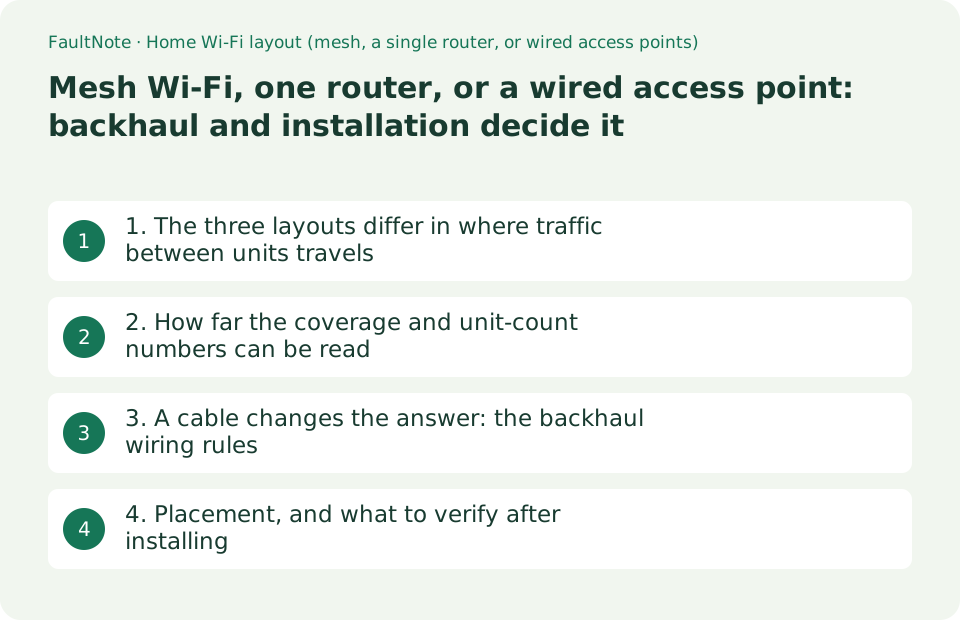
1. The three layouts differ in where traffic between units travels
There are three broad options: cover everything with one router, use a mesh of several nodes, or add access points over Ethernet. What separates them is the backhaul — where traffic between the units travels. Most mesh systems link the main unit and its satellites over Wi-Fi, and that link shares the same airspace as your client devices.
The Wi-Fi Alliance describes Wi-Fi EasyMesh as bringing "a standards-based approach to Wi-Fi networks that utilize multiple APs", with APs that work together to form a unified network, that "can guide devices to the best AP and modify the network structure based on changing conditions". The capabilities it lists are flexible design through best placement of multiple APs, seamless and secure onboarding with QR codes through Wi-Fi Easy Connect, prioritising low-latency applications while guiding devices to roam and avoid interference, and scalability by adding EasyMesh APs from multiple vendors.
A wired access point links units with a LAN cable instead. TP-Link's Omada EAP653 (AX3000, ceiling mount) lists power as 802.3at PoE or 12V/1.5A DC with the adapter not included, plus 48V passive PoE, a maximum power consumption of 15.5 W, a single Gigabit Ethernet port, coverage of up to 1,500 square feet (140 square metres) and 250-plus concurrent clients — with footnotes on the same page stating that the coverage value "is calculated based on laboratory testing" and is not guaranteed, and that the actual client capacity "is generally less than the maximum number of client connections". Management runs through the Omada app, a web browser, a hardware or software controller, or the cloud. It is less turnkey than a consumer mesh kit, but PoE carrying power and data on one cable buys real freedom in where the unit goes.
The first branch is therefore simple. If you can run a cable to the room that has no signal, wired-backhaul mesh or a wired access point becomes the strong option. If you cannot, you are on wireless backhaul and you accept the unit-count and placement constraints described below.
Scroll horizontally to see the full table →
| Layout | Traffic between units | When it fits |
|---|---|---|
| A single router | None (one unit does everything) | No dead zones, or one dead zone that moving the router can fix |
| Mesh with wireless backhaul | Main and satellite link over Wi-Fi, sharing airtime with your devices | No cabling possible but several rooms or floors to cover |
| Mesh with Ethernet backhaul | Units linked by LAN cable; the Wi-Fi backhaul disconnects automatically | Ethernet already installed, thick walls or several floors, latency-sensitive use |
| Wired access point | LAN cable; with PoE no mains outlet is needed at the mounting point | You want to choose the mounting position, or need management features |
| Mixing vendors | The Wi-Fi Alliance states EasyMesh APs from multiple vendors can be added | Check EasyMesh support on both sides before relying on it |
| Common to all | The line and the modem or ONU still cap everything | Rearranging the inside of the house does not exceed the plan you pay for |
2. How far the coverage and unit-count numbers can be read
Coverage on a product page is written as a conditional estimate. TP-Link's Deco BE25 page states "Up to 2,600 sq. ft. (1-pack)" and heads the page with "Whole-Home Coverage Up to 6,600 Sq. Ft." - without saying how many units that larger figure assumes - plus more than 150 connected devices. The same page notes that the 150-device figure "is based on laboratory test data, which analyzed the connections of different devices on the 5 GHz, and 2.4 GHz bands simultaneously", simulating a typical home running 4K video, 1080p video, downloads, browsing, IP cameras and other IoT devices in one room. It then states that "actual wireless data throughput, wireless coverage, and connected devices are not guaranteed and will vary as a result of internet service provider factors, network conditions, client limitations, and environmental factors, including building materials, obstacles, volume and density of traffic, and client location".
Unit counts come with published ceilings too. TP-Link's FAQ (updated 17 April 2026) recommends up to six units per network for most Deco models on Wi-Fi or PLC backhaul, notes that selected Wi-Fi 6, 6E and 7 models (Deco X68, X90, XE75, BE95, BE85 and similar) may go beyond six if needed, and says that with Ethernet backhaul — or a hybrid of Ethernet and Wi-Fi — there is theoretically no unit limit, while still recommending six or fewer for Wi-Fi 5 models such as the Deco E4, M4 and P9 so the app stays responsive.
The caveat in the same FAQ matters most: "Adding more Deco units does not always improve wireless throughput or stability. If there are no dead zones, additional units may not be necessary", and "the recommendations above are for reference only. Actual performance can vary depending on your home layout, obstacles, and the distances between Deco units." Units are not the fix in themselves; they are what you add where signal does not reach.
That points at something you can test before spending. If only one room fails and the router sits in a cabinet or behind metal furniture, moving it is the more reliable first move. TP-Link's own guidance says not to place units inside closets, TV cabinets or other enclosed areas.
Scroll horizontally to see the full table →
| The figure shown | The condition the maker attaches | How to treat it when buying |
|---|---|---|
| Deco BE25: up to 2,600 sq ft with one unit | Actual coverage is not guaranteed and varies with building materials, obstacles and traffic | An area estimate; no two homes have the same walls |
| Deco BE25: headline figure of up to 6,600 sq ft (no unit count stated) | As above | Read it as a multi-unit total; one unit does not reach further |
| More than 150 devices | Based on laboratory test data simulating 4K video, IP cameras and other loads together | Read it against the mix and number of devices you actually run |
| Units on wireless backhaul | Up to six recommended for most models (selected Wi-Fi 6, 6E and 7 models may exceed) | A recommended ceiling, not an argument that more is better |
| Units on Ethernet backhaul | Theoretically unlimited, though Wi-Fi 5 models are still capped at six by recommendation | Cabling buys freedom in how many units you run |
| The effect of adding units | The FAQ says additional units may not be necessary where there are no dead zones | Locate the dead zone first, then decide the count |
3. A cable changes the answer: the backhaul wiring rules
TP-Link's Ethernet backhaul FAQ (updated 17 April 2026) describes the feature as connecting Deco units with Ethernet cables to create "a wired backhaul mesh network that delivers faster, more stable performance than a wireless connection between nodes". The reason is stated plainly: because the data travels over a wired connection "it does not need to use any of the wireless bandwidth that would otherwise be shared with your connected devices", giving lower latency and no bandwidth loss from a wireless hop. TP-Link positions it for multi-storey homes, spaces with thick walls, homes already wired with Ethernet, and demanding uses such as gaming or 4K streaming.
Wiring rules depend on the operating mode. In Router mode (the default), satellite units must connect to the main unit's LAN port, or to a switch that is itself connected to that LAN port; connecting a satellite directly to the modem or router in front of the main unit creates a network loop and is ruled out. In Access Point mode the upstream router handles routing, so satellites can connect to any Deco unit or to the main modem/router. You do not have to wire every unit, and wired and wireless backhaul can coexist in one network.
The setup order and the failure modes are published as well. Set all units up wirelessly in the app first, place them, then connect the Ethernet cables; the backhaul activates on its own, and the Wi-Fi backhaul between those two units disconnects automatically once the wired link is detected. If it does not take effect, the FAQ lists the checks: the IPTV port cannot be used for backhaul when IPTV is enabled, try another port, try another cable, and connect two units directly to rule the switch in or out. It also notes that switching from Wi-Fi to Ethernet backhaul may create a short loop of one to two seconds, so a switch with loop detection may block the port — turn that function off and reboot.
If you choose a wired access point instead, power and mounting are the deciding details. The EAP653 runs on 802.3at PoE or DC power (adapter not included) at up to 15.5 W through a single Gigabit port. PoE means you also need a PoE switch or injector, in exchange for one cable carrying both power and data, and management assumes an Omada controller or the app. For one or two units in a home, the Ethernet backhaul of a consumer mesh kit is the simpler path.
Scroll horizontally to see the full table →
| Item | What TP-Link publishes | What it means in practice |
|---|---|---|
| Wiring in Router mode | Satellites go to the main unit's LAN port or a switch on that port; never directly to the upstream modem or router | Less freedom in routing cables; avoiding a loop is mandatory |
| Wiring in Access Point mode | Satellites may connect to any unit or to the upstream modem/router | Easier cabling when you keep your existing router |
| Wiring every unit | Not required; wired and wireless backhaul can be mixed | Wire the rooms you can and leave the rest wireless |
| How the switch-over works | When a wired link is detected, the Wi-Fi backhaul between those units disconnects automatically | No configuration needed; confirm in the app's network map |
| If it does not activate | IPTV port unusable, change port, change cable, connect directly without the switch | A stepwise way to isolate the cause |
| Switch loop detection | The one-to-two-second loop during switch-over can trip it; disable the function and reboot | Worth checking when reusing an existing switch |
| Powering a wired AP | EAP653: 802.3at PoE or 12V DC (adapter not included), up to 15.5 W, one Gigabit port | A PoE switch or injector becomes part of the purchase |
4. Placement, and what to verify after installing
On wireless backhaul, placement decides almost everything. TP-Link's placement guide (updated 17 April 2026) says to put satellites at the same height as the source unit, ideally one to one and a half feet off the floor, in an open area away from walls and metal objects such as metal filing cabinets, and away from microwaves, Bluetooth devices and USB 3.0 devices, which it names as interference on the 2.4 GHz band. During placement it tells you to check the signal strength from the source unit in the app, with two bars as the recommended level. Another TP-Link FAQ states not to put units in closets, TV cabinets or other enclosed spaces.
How to measure speed has published caveats as well. TP-Link's FAQ (updated 24 August 2026) states that the speed test in the Deco app (Deco > Network > Test Internet Speed) "measures only the main Deco unit's connection speed, not the speed that individual connected devices receive". For a wired test it asks you to confirm that the cable and the PC port match the router's port rate, noting that a 100 Mbps port caps results at around 90 Mbps regardless of your plan. Before a wireless test it asks you to disconnect other wireless devices and to reconnect the phone or laptop to Wi-Fi first, because some devices attach to the wrong node and report lower speeds.
Two early compatibility issues are documented too. TP-Link's troubleshooting article (updated 17 April 2026) states that Fast Roaming is a known compatibility issue and that some devices cannot connect while it is enabled, with disabling it under More > Advanced > Fast Roaming often resolving the problem. It also notes that smart home devices supporting only 2.4 GHz may fail to join while the 5 GHz network is active during setup, and that temporarily disabling 5 GHz can resolve it. These are the first places to look if something will not connect on day one.
For the standards themselves, this site has a separate guide to Wi-Fi 6 versus Wi-Fi 7; the PC end of the link is covered in the USB versus PCIe adapter guide, and cabling in the LAN cable category guide. This article deliberately stays on the middle question: how to distribute signal inside the house.
Scroll horizontally to see the full table →
| Situation | What to check | Source (TP-Link's published guidance) |
|---|---|---|
| Placing a satellite | Same height as the source unit, one to one and a half feet off the floor, in the open | Placement guide (updated 17 April 2026) |
| Interference | Away from walls and metal furniture; microwaves, Bluetooth and USB 3.0 devices affect 2.4 GHz | Same guide |
| Verifying the position | Check signal strength from the source unit in the app; two bars recommended | Same guide |
| Measuring speed | The app test covers the main unit only; reconnect the client before each test | Speed FAQ (updated 24 August 2026) |
| Testing over Ethernet | Cable and PC port must match the router's port rate (a 100 Mbps port caps around 90 Mbps) | Same FAQ |
| A device that will not join | Disable Fast Roaming; disable 5 GHz temporarily for 2.4 GHz-only devices | Connection troubleshooting FAQ (updated 17 April 2026) |
Limitations and requirements
- Coverage areas, device counts and speeds are manufacturer figures, and TP-Link itself notes that actual throughput, coverage and connected devices are not guaranteed. This site did not measure any wireless network. Treat the numbers as conditional estimates.
- The wiring rules and recommended unit counts are written for TP-Link Deco and do not transfer unchanged to other makers or other product lines. Check the manual and FAQ for your own product before installing; wiring that creates a loop causes outages.
- This article does not cover prices, stock or rankings. The products named are examples that make the published conditions readable. The specifications and FAQs were checked on 19 September 2026, and each FAQ is quoted with the update date shown on it.
Frequently asked questions
Will adding more units make Wi-Fi faster?
Not necessarily. TP-Link's FAQ states that "adding more Deco units does not always improve wireless throughput or stability. If there are no dead zones, additional units may not be necessary." The same FAQ recommends up to six units for most models on Wi-Fi or PLC backhaul (selected Wi-Fi 6, 6E and 7 models may exceed that), and says that with Ethernet backhaul or a hybrid there is theoretically no unit limit. The reliable order is to find where signal is missing first, then add units to reach that place.
What actually changes with Ethernet backhaul?
TP-Link explains that linking units by cable means the traffic between them "does not need to use any of the wireless bandwidth that would otherwise be shared with your connected devices", so there is no bandwidth loss from a wireless hop and latency is lower. Setup is to configure all units wirelessly in the app first and then connect the cables: the backhaul activates by itself and the Wi-Fi backhaul between those units disconnects. In Router mode, though, satellites must connect to the main unit's LAN port or to a switch on it — connecting to the upstream modem or router creates a loop. You do not have to wire every unit, and mixing wired and wireless backhaul is supported.
Is the app's speed test showing my device's speed?
No. TP-Link's FAQ states that the speed test in the Deco app (Deco > Network > Test Internet Speed) "measures only the main Deco unit's connection speed, not the speed that individual connected devices receive". To test from a client, the same FAQ asks you to disconnect other wireless devices, reconnect the client to Wi-Fi before testing (some devices attach to the wrong node and report low figures), and, for a wired test, confirm that the cable and the PC's port match the router's port rate. It gives the example that a 100 Mbps port caps results at around 90 Mbps regardless of the internet plan.
Sources and verification date
Sources checked: . These sources support the specifications, procedures or prices discussed here. Check each source for applicable conditions and current information.
- Wi-Fi Alliance: Wi-Fi EasyMesh (multiple APs working together, multi-vendor) ↗
- TP-Link FAQ: Deco Ethernet backhaul (updated 17 April 2026) ↗
- TP-Link FAQ: how many Deco units do I need (recommended counts and caveats, updated 17 April 2026) ↗
- TP-Link FAQ: Deco placement guide (updated 17 April 2026) ↗
- TP-Link FAQ: fixing slow Deco internet speed (updated 24 August 2026) ↗
- TP-Link FAQ: devices cannot connect to Deco Wi-Fi (updated 17 April 2026) ↗
- TP-Link: Deco BE25 product page (coverage and device-count claims with footnotes) ↗
- TP-Link: Omada EAP653 product page (802.3at PoE, 15.5 W, 1,500 sq ft) ↗
Related practical guides
- Check PC-Part Compatibility Before Buying: CPU, BIOS, RAM, Case and Power
- Air cooler or AIO? Choose by case clearance, noise and maintenance
- PCIe 4.0 or 5.0 SSD for gaming? Check load times, capacity and slot sharing
- DDR4 vs. DDR5: Choose for a New Build, Reused RAM and Upgrade Cost
- DDR5 with Two or Four DIMMs: Compare Upgrade Speed Limits and Kits
- Integrated vs. Discrete Graphics: Check Workloads, CPU Models and Outputs