Japan's 6 GHz Wi-Fi rules: how many 320 MHz channels, and which devices may go outdoors
"The Wi-Fi 7 standard supports 320 MHz" and "320 MHz is available to you in Japan" are different statements. The comparison table published by Japan's radio-use portal allocates 5925-6425 MHz to wireless LAN at 6 GHz, lists occupied bandwidths of 20/40/80/160/320 MHz, and gives the corresponding channel counts as 24/12/6/3/2. Only two channels' worth of 320 MHz width exists. The band also splits into two power modes: indoor-only LPI at e.i.r.p. 200 mW and outdoor-capable VLP at e.i.r.p. 25 mW, where "indoor" is defined to include trains, ships and aircraft but to exclude the inside of a car. This guide sets out what to check on the regulatory side before buying. It does not cover raising output or using indoor-only equipment outdoors.
Published · Updated · FaultNote editorial policy
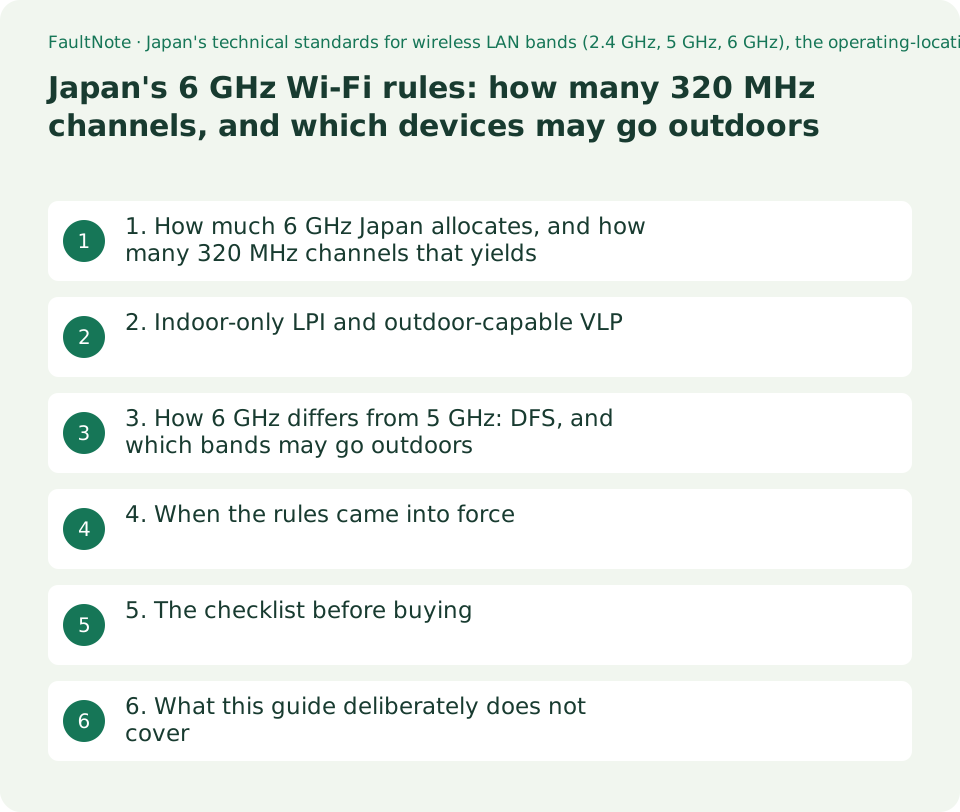
Who this guide is for and what to prepare
- Readers about to buy a Wi-Fi 7 router whose box says 320 MHz
- Readers who want coverage outdoors, on a balcony, in a garden or a car park
- Readers wondering why the 6 GHz channel diagrams in overseas reviews do not match what Japanese product pages say
What you need
- Decide whether the installation is indoor-only or needs to radiate outdoors
- On each candidate router's product page, find the supported bands and widths and any statement about indoor or outdoor use
- Remember the PC side is a separate matter; see this site's guide to Windows 11's per-feature requirements as well
1. How much 6 GHz Japan allocates, and how many 320 MHz channels that yields
The radio-use portal page on low-power data communication systems lists the bands allocated to wireless LAN in Japan as 2.4 GHz (2400-2483.5 MHz), a Japan-only 2.4 GHz segment (2471-2497 MHz), 5 GHz split into 5.2 GHz (5150-5250 MHz), 5.3 GHz (5250-5350 MHz) and 5.6 GHz (5470-5730 MHz), and 6 GHz (5925-6425 MHz). Read 2026-09-20.
In the technical-standards comparison table on the same page, the 6 GHz occupied bandwidths are given as 20/40/80/160/320 MHz and the channel counts as 24/12/6/3/2. The lists run in the same order, so the channel count corresponding to 320 MHz is two. That is what a "320 MHz capable" label is capable of, here.
These figures are Japan's. Allocations at 6 GHz differ between countries, so an overseas channel chart cannot simply be applied here. This guide does not state how much other countries allocate, because no primary source for that was read in preparing it.
Scroll horizontally to see the full table →
| Item | 2.4 GHz (2400-2483.5 MHz) | 5.2 GHz (5150-5250 MHz) | 5.3 GHz (5250-5350 MHz) | 5.6 GHz (5470-5730 MHz) | 6 GHz (5925-6425 MHz) |
|---|---|---|---|---|---|
| Occupied bandwidth | 26/40 MHz | 20/40/80/160 MHz | 20/40/80/160 MHz | 20/40/80/160 MHz | 20/40/80/160/320 MHz |
| Channel count | 3/1 ch | 4/2/1/1 ch | 4/2/1/1 ch | 12/6/3/1 ch | 24/12/6/3/2 ch |
| DFS | Not required | Not required | Required | Required | Not required |
| Operating location | Indoor and outdoor, airborne use permitted | Indoor and inside a car | Indoor only | Indoor and outdoor, excluding airborne use | LPI: indoor only / VLP: indoor and outdoor, excluding airborne use |
| Antenna power | Wireless LAN 260 mW/200 mW, others 10 mW | Indoor 200 mW, inside a car 40 mW | 200 mW | 200 mW, e.i.r.p. 1 W | Indoor (LPI) e.i.r.p. 200 mW / outdoor (VLP) e.i.r.p. 25 mW |
2. Indoor-only LPI and outdoor-capable VLP
The 6 GHz section of the same page states that the band has two power modes, LPI (Low Power Indoor) restricted to indoor use and VLP (Very Low Power) usable outdoors, and tells readers to check which mode their equipment uses before taking it outside. LPI is described as transmitting at the equivalent of e.i.r.p. 200 mW and permitted only indoors; VLP transmits at the lower equivalent of e.i.r.p. 25 mW, may be used outdoors, but not airborne.
The page adds that, in order to prevent outdoor use, technical conditions concerning power supply and construction are imposed on LPI base stations (access points). Repurposing an indoor access point for outdoor mounting is therefore outside the assumptions the rules are built on, not merely discouraged.
The definition of "indoor" matters too. A note on the page states that indoor includes the inside of trains, ships and aircraft, and that the inside of a car is not included - a car counts as outdoors. Anyone planning to use 6 GHz equipment in a vehicle runs straight into this.
Scroll horizontally to see the full table →
| Mode | Antenna power | Where it may be used | Note, as published |
|---|---|---|---|
| LPI (Low Power Indoor) | Equivalent of e.i.r.p. 200 mW | Indoor only, including trains, ships and aircraft but not the inside of a car | To prevent outdoor use, technical conditions on power supply and construction are imposed on the base station |
| VLP (Very Low Power) | Equivalent of e.i.r.p. 25 mW | Indoor and outdoor. Not permitted airborne | Transmit power is lower than LPI |
| LPI device-to-device communication | Follows the LPI conditions | Indoor | Additional standards: it may operate only while the received LPI base-station signal is at or above -95 dBm/MHz, checked at least once every 4 seconds |
| VLP device-to-device communication | Follows the VLP conditions | Indoor and outdoor | Described as having no particular technical conditions and usable outdoors |
3. How 6 GHz differs from 5 GHz: DFS, and which bands may go outdoors
DFS is listed as not required at 6 GHz. At 5.3 GHz and 5.6 GHz, by contrast, the outdoor-use page notes that DFS capability is mandatory regardless of whether the equipment is indoors or outdoors. The reason given is spectrum sharing: the pages state that 5 GHz wireless LAN shares frequencies with other systems, weather radar among them.
It is worth not turning that into a causal claim. A band being exempt from DFS in the rules is a different statement from that band being more stable in use. Nothing was measured here, so this guide does not say 6 GHz drops out less often. What it can say is that some bands are required to carry radar-avoidance behaviour and others are not.
The outdoor page carries one more practical statement. For 5.2 GHz it says that the tethering function of mobile routers and smartphones may not be used outdoors at 5.2 GHz, and that tethering remains indoor-only. If you rely on tethering outdoors, check which band your equipment uses.
Scroll horizontally to see the full table →
| Band | Indoor use | Outdoor use | Airborne use |
|---|---|---|---|
| 2.4 GHz (2400-2497 MHz) | Permitted | Permitted | Permitted |
| 5.2 GHz (5150-5250 MHz) | Permitted | Conditional | Conditional |
| 5.3 GHz (5250-5350 MHz) | Permitted | Not permitted | Not permitted |
| 5.6 GHz (5470-5730 MHz) | Permitted | Permitted | Not permitted |
| 6 GHz (5925-6425 MHz) | Permitted | LPI not permitted, VLP permitted | Not permitted |
4. When the rules came into force
The reference section of the radio-use portal page carries a revision history. The revision of 2 September 2022 (Reiwa 4) is recorded as introducing 6 GHz (5925-6425 MHz) wireless LAN and in-car 5.2 GHz wireless LAN. The revision of 22 December 2023 (Reiwa 5) is recorded as making the regulatory changes for the introduction of the IEEE 802.11be standard, introducing LPI device-to-device communication at 6 GHz, and revising in-car 5.2 GHz wireless LAN. Read 2026-09-20.
So IEEE 802.11be, the standard behind Wi-Fi 7, entered Japan's rules with the December 2023 revision. "When did Wi-Fi 7 become usable in Japan?" can be answered from that primary record rather than from press coverage.
The same history records the revision of 11 July 2019 (Reiwa 1) as making the regulatory changes for IEEE 802.11ax and extending 5.6 GHz with channel 144. Rules are revised, so read this article as describing the position on the observation date.
Scroll horizontally to see the full table →
| Revision | Content, as recorded | What it tells a buyer |
|---|---|---|
| 2 September 2022 | Introduced 6 GHz (5925-6425 MHz) wireless LAN. Introduced in-car 5.2 GHz (5150-5250 MHz) wireless LAN. | When 6 GHz wireless LAN entered Japan's rules |
| 22 December 2023 | Regulatory changes for the introduction of the IEEE 802.11be standard. Introduced 6 GHz LPI device-to-device communication. Revised in-car 5.2 GHz wireless LAN. | When the standard behind Wi-Fi 7 entered Japan's rules |
| 11 July 2019 | Regulatory changes for the introduction of the IEEE 802.11ax standard. Extended 5.6 GHz with channel 144. | When Wi-Fi 6 arrived; useful when judging older equipment |
5. The checklist before buying
First, settle the installation. Indoor-only is straightforward with LPI equipment. If you need to radiate outdoors at 6 GHz, only VLP (the equivalent of e.i.r.p. 25 mW) is permitted, so look for that on the product page. Indoor equipment cannot be repurposed for outdoor mounting.
Second, if you are buying for the 320 MHz width, start from the fact that only two channels' worth of it exists in Japan's 6 GHz allocation. One can reasonably decide not to count on being clear of the neighbours, but this guide will not put a figure on congestion, because no radio environment was measured.
Third, the PC end has to line up separately. Microsoft states that Wi-Fi 7 requires "Windows 11 version 24H2 or later ... with a Wi-Fi 7 capable network adapter and compatible drivers", and that full functionality including Multi-Link Operation, 320 MHz channels and WPA3 requires a Wi-Fi 7 router or access point. This site's guide to Windows 11's per-feature requirements goes into that.
6. What this guide deliberately does not cover
It does not describe how to raise output, how to use indoor-only LPI equipment outdoors, or how to switch a device to an overseas regulatory profile. Those touch the Radio Act, and this site does not publish such procedures.
It quotes no throughput figures either. "6 GHz gives you X Mbps" is not something this site measured. Nor will it name a product and assert that it is a VLP device: which power mode a device implements is something to confirm from the manufacturer's own marking.
One point that is easy to mix up: the outdoor-use page records that, following a partial report from the Information and Communications Council in December 2024, conditional airborne use became possible from April 2025. That statement is about the 5.2 GHz band, not 6 GHz. At 6 GHz, airborne use is listed as not permitted.
Limitations and requirements
- Indoor-only LPI equipment may not be installed and used outdoors. The ministry's page states that technical conditions on power supply and construction are imposed on LPI base stations specifically to prevent outdoor use.
- "Indoor" includes the inside of trains, ships and aircraft, but not the inside of a car, which counts as outdoors. This matters if you were planning to use the equipment in a vehicle.
- DFS being listed as not required at 6 GHz does not mean the band is more stable. A regulatory requirement and real-world link quality are different things, and nothing was measured here.
- The April 2025 relaxation of airborne use on the outdoor-use page concerns the 5.2 GHz band. Airborne use at 6 GHz is listed as not permitted.
Frequently asked questions
My router says 320 MHz but it only ever connects at 160 MHz.
Start from the allocation: only two channels' worth of 320 MHz width exists in Japan's 6 GHz band - the portal's table pairs channel widths of 20/40/80/160/320 MHz with channel counts of 24/12/6/3/2. Beyond that, the width actually negotiated depends on the router's settings, what the client supports, and the local radio environment. No single cause can be asserted without measuring your environment. Check the 6 GHz channel-width setting in the router's configuration page and what the client adapter supports.
Can I mount an access point on a balcony or in the garden?
At 6 GHz, only VLP equipment (the equivalent of e.i.r.p. 25 mW) may be used outdoors; LPI equipment is indoor-only and cannot be installed outside. If you use 5 GHz instead, 5.3 GHz is indoor-only while 5.6 GHz may be used outdoors but not airborne. Which mode a given device implements is something to confirm from the manufacturer's marking.
Why do overseas reviews show more 6 GHz channels than Japanese pages do?
Because the allocation differs by country. Japan's ministry records 5925-6425 MHz as allocated to wireless LAN at 6 GHz. This guide does not compare that against other countries' allocations, because no primary source for those was read. For a decision about equipment in Japan, use Japan's figures.
Are there limits on using phone tethering while out and about?
The outdoor-use page states, for the 5.2 GHz band, that the tethering function of mobile routers and smartphones may not be used outdoors at 5.2 GHz and that tethering remains indoor-only. If you tether outdoors, check which band the equipment is using. At 6 GHz, only VLP devices may be used outdoors.
Sources and verification date
Sources checked: . These sources support the specifications, procedures or prices discussed here. Check each source for applicable conditions and current information.
- MIC radio-use portal: low-power data communication systems (wireless LAN and similar). Band allocations, the comparison table of technical standards (occupied bandwidth, channel count, DFS, operating location, antenna power), the 6 GHz LPI / VLP and device-to-device standards, and the revision history. Read 2026-09-20 ↗
- MIC radio-use portal: outdoor and airborne use of wireless LAN. The per-band indoor / outdoor / airborne table, the note that DFS is mandatory at 5.3 GHz and 5.6 GHz, and the statement about tethering at 5.2 GHz. Read 2026-09-20 ↗
- Microsoft: Windows 11 specifications, features, and computer requirements. The Wi-Fi 7 per-feature requirement (version 24H2 or later, a capable adapter and drivers, and a Wi-Fi 7 router or access point for full functionality). Read 2026-09-20 ↗
Related practical guides
- Wi-Fi 6, 6E or 7? Check your Windows PC before buying a router
- Mesh Wi-Fi, one router, or a wired access point: backhaul and installation decide it
- Japan's technical conformity mark: what to check before importing a wireless PC accessory
- USB vs PCIe Wi-Fi Adapter: Check Installation Requirements, Bluetooth and Speed Labels Before Buying