Adding Bluetooth to a desktop PC: reading a USB adapter's version number, placement and limits
A Bluetooth adapter is an easy part to add, but picking the one labelled 5.4 is not what makes audio better or connections steadier. Microsoft publishes both how to read your PC's supported version from the LMP number in Device Manager and the table that maps LMP to a Bluetooth Core Specification, and it states alongside them that "the LMP version is the highest core specification that the Windows device fully supports" and that "accessories with higher specifications might still work, but with reduced functionality". The version number, in other words, is a ceiling. What decides whether the purchase works is whether the maker lists your Windows version at all, whether the thing physically fits the port you have, and which limits remain for the way you will use it - the profile switch that degrades headset audio, and the conditions Microsoft sets for LE Audio. This guide builds the pre-purchase checklist from those published procedures, product specifications and stated conditions.
Published · Updated · FaultNote editorial policy
Who this guide is for and what to prepare
- People with a desktop or self-built PC that has no Bluetooth, who want a wireless mouse, keyboard or headphones
- People who do not know which Bluetooth version their PC supports and cannot tell whether an adapter is needed
- People whose adapter is plugged in but whose device does not appear, or whose audio drops out, and who want to diagnose before buying again
What you need
- Whether the PC has Bluetooth at all (a Bluetooth node in Device Manager, or the statement on the motherboard or PC specification page)
- Which USB ports are free and of what generation (front or rear, and whether a USB 3.0 port sits next to it)
- The devices you intend to connect and the Bluetooth version and profiles they need (mouse, keyboard, headset, game controller)
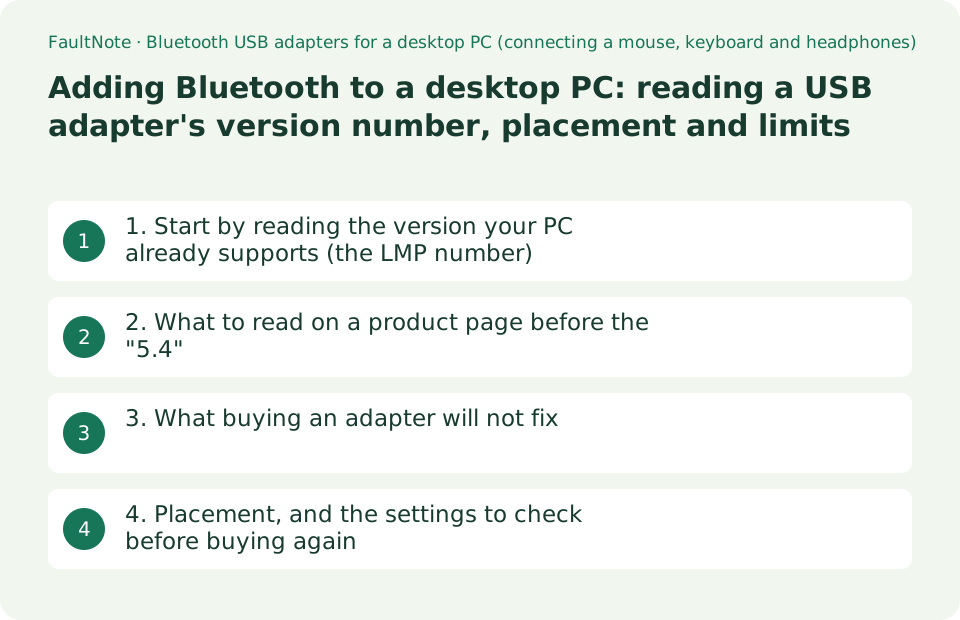
1. Start by reading the version your PC already supports (the LMP number)
Microsoft publishes the procedure for finding the Bluetooth version on a Windows PC. Right-click Start, open Device Manager and expand the arrow next to Bluetooth. Several entries are listed there, but the one that carries a version is the radio. Its name varies with the module manufacturer, and Microsoft gives "Intel(R) Wireless Bluetooth(R)" and "Realtek Bluetooth Adapter" as examples. It also names the entries that are not the radio: "Bluetooth Device (RFCOMM Protocol TDI)", "Microsoft Bluetooth Enumerator" and "Microsoft Bluetooth LE Enumerator".
Right-click the radio, open Properties, and on the Advanced tab read the LMP number next to Firmware Version in the Bluetooth Radio Information section. Microsoft publishes the mapping from LMP to Bluetooth Core Specification: LMP 9 is 5.0, 10 is 5.1, 11 is 5.2, 12 is 5.3, 13 is 5.4 and 14 is 6.0. Below those, LMP 6 is 4.0, 7 is 4.1 and 8 is 4.2, while LMP 5 and lower (3.0 and earlier) are annotated as deprecated or withdrawn.
The check is worth doing because of the condition Microsoft states just before that table: "The LMP version is the highest core specification that the Windows device fully supports. Accessories with higher specifications might still work, but with reduced functionality." The page also notes that "Bluetooth accessories sometimes require a minimum Bluetooth specification (version) in order to work with full functionality". So the PC's version is a ceiling, and the decision is whether it meets what the accessory you want asks for.
If there is no Bluetooth node at all, the machine may simply not have it. Microsoft's troubleshooting article opens with the same point: "If you're setting up a new device and Bluetooth is missing, check the product specifications to make sure it has Bluetooth capabilities. Some devices don't have Bluetooth." On a self-built desktop the motherboard specification table settles it. If the Bluetooth entry disappeared rather than never existing, that is a different problem, and our separate troubleshooting article covers it.
Scroll horizontally to see the full table →
| LMP number in Device Manager | Bluetooth Core Specification (Microsoft's table) | What it means for the purchase |
|---|---|---|
| LMP 6 / 7 / 8 | 4.0 / 4.1 / 4.2 | May fall short of what current accessories ask for; a candidate for adding an adapter |
| LMP 9 | 5.0 | The same generation as current dongles such as the ASUS USB-BT500 |
| LMP 10 / 11 | 5.1 / 5.2 | The PC tops out at 5.2; higher-spec accessories may work but with reduced functionality |
| LMP 12 / 13 | 5.3 / 5.4 | The same generation as the TP-Link UB500 Plus (5.3) and UB500 (5.4) |
| LMP 14 | 6.0 | The top of the table; few peripherals require this version today |
| LMP 5 or lower | 3.0 + HS and earlier (annotated deprecated or withdrawn) | With an old built-in radio, consider adding rather than replacing |
2. What to read on a product page before the "5.4"
Within one brand and one price bracket, the version number and the physical design can move in opposite directions. TP-Link's UB500 is a Bluetooth 5.4 nano adapter measuring 14.8 x 6.8 x 18.9 mm, with supported operating systems listed as Windows 11/10/8.1/7. The UB500 Plus, which looks like the senior product, is version 5.3 and instead carries an adjustable multi-directional antenna in an 81 x 42 x 16.8 mm body. Whether you want the newer version or the antenna and the body decides which one you buy.
Always check which operating systems are listed. The ASUS USB-BT500 specification table gives Bluetooth 5.0+EDR and Bluetooth Smart (Bluetooth low energy), an interface of USB 2.0 Type A, data rates of up to 3 Mbps for classic BT-BR/EDR and 2 Mbps for BLE, and a distance of use of up to 10 meters for classic and up to 40 meters for BLE in open space - but its OS Support row reads "Windows 8.1/10, Linux", with no Windows 11 (as published on the Tech Specs page captured on 2026-09-19). Read it as a statement of how far the maker commits, not as proof that it will or will not run.
Placement is part of the specification too. A nano dongle goes in easily even where the rear ports are crowded, but with a tower under the desk there is a metal case and a long distance between it and your accessories. The UB500 Plus with its antenna is 81 mm long and may block the neighbouring port. TP-Link states for both the UB500 and the UB500 Plus, in the same wording, that they support up to 7 Bluetooth devices at once and 2x faster transmission speeds, and then adds the footnote "Speed, distance, and capacity data is based on laboratory testing. Exact performance may vary in actual use." The catalogue numbers are ceilings, not guarantees for your room.
Drivers are covered as well. TP-Link says the UB500 Plus installs by plug and play in under a minute for most devices, but states that on Windows 7 you need the driver from its download centre, and adds: "To ensure compatibility after an OS update, you may need to update the adapter's drivers." That is the first place to look when behaviour changes after a Windows feature update.
Scroll horizontally to see the full table →
| Item (as published) | TP-Link UB500 | TP-Link UB500 Plus / ASUS USB-BT500 |
|---|---|---|
| Bluetooth version | 5.4 | UB500 Plus: 5.3 / USB-BT500: 5.0+EDR plus Bluetooth low energy |
| Interface | USB (nano size) | UB500 Plus: USB with antenna / USB-BT500: USB 2.0 Type A |
| Dimensions | 14.8 x 6.8 x 18.9 mm | UB500 Plus: 81 x 42 x 16.8 mm / USB-BT500: 7.1 x 14.9 x 17.4 (no unit stated on the page), 1.9 g |
| Operating systems listed | Windows 11/10/8.1/7 | UB500 Plus: Windows 11/10/8.1/7 (driver needed on Win 7) / USB-BT500: Windows 8.1/10, Linux |
| Speed and distance figures | No individual figures on the product page | USB-BT500: up to 3 Mbps classic and 2 Mbps BLE; up to 10 m classic and 40 m BLE in open space |
| Simultaneous devices and footnotes | Up to 7 devices, 2x faster transmission (with the laboratory-testing footnote) | UB500 Plus: the same wording and the same footnote / USB-BT500: not stated |
3. What buying an adapter will not fix
Headset audio is the most misunderstood case. In Bluetooth Classic Audio, A2DP is output-only stereo playback while HFP handles microphone and playback together at narrowband 8 kHz or wideband 16 kHz, and Windows 11 selects HFP when an app opens the microphone endpoint or creates an output stream with the Communications category. That is why audio turns telephone-like the moment a meeting app starts, and no adapter version number changes the specification. Our separate guide on headset connection types covers it in full.
LE Audio is the answer to that, but the conditions Microsoft publishes are hard on an add-on dongle. For stereo playback while the microphone is in use, it states that "your PC must be running Windows 11, version 24H2 or newer and have integrated support for Bluetooth LE from the factory. Additionally, it must have the necessary drivers from the manufacturer to support Bluetooth LE Audio with stereo functionality." Read literally, a USB dongle added afterwards does not meet the factory-integration condition - that reading is ours, and Microsoft does not name dongles specifically. If you want stereo while the microphone is live, a USB or 2.4 GHz-dongle headset is the more certain route.
Range and throughput are not settled by the adapter alone either. The up to 10 meters (classic) and up to 40 meters (BLE) that ASUS publishes carry the condition "in open space", which is not the same as coming out of the back of a metal case under a desk, and TP-Link's figures carry the laboratory-testing footnote. Treat the catalogue numbers as ceilings for comparison, and settle the installation with the next section.
What an adapter reliably fixes is the case where there is no Bluetooth node at all. Adding a PCIe Wi-Fi card that carries Bluetooth is another route, but then the card's Bluetooth cable has to reach an F_USB header on the motherboard - TP-Link states that if it is not connected correctly, Bluetooth will not work even after driver installation. Our separate guide compares USB adapters with PCIe cards on that basis.
Scroll horizontally to see the full table →
| The symptom or the wish | Does buying an adapter change it? | Basis (as published) |
|---|---|---|
| Headset audio degrades as soon as a meeting app opens | No | It is the Classic Audio specification; Windows 11 selects HFP when the microphone is used |
| Stereo playback while the microphone is live (LE Audio) | Likely fails the stated conditions | Microsoft requires 24H2 or newer, factory-integrated Bluetooth LE and manufacturer drivers |
| The PC has no Bluetooth node at all | Yes | Microsoft also notes that "some devices don't have Bluetooth" |
| An old built-in radio (LMP 6-8) falls short of an accessory | Adding one can help | The LMP version is the ceiling of full support; higher-spec accessories may lose functionality |
| You want to use it from further away | Depends on the product, and the figures are not guarantees | ASUS states open space; TP-Link states laboratory testing |
| You want Wi-Fi and Bluetooth in one go | A PCIe card is an alternative | But TP-Link states Bluetooth will not work unless the cable is connected to the F_USB header |
4. Placement, and the settings to check before buying again
Microsoft is explicit about placement in its troubleshooting article: "If your Bluetooth device is unresponsive or sluggish, check to make sure it's not too close to any other USB device that's plugged into a USB 3.0 port. Unshielded USB devices can sometimes interfere with Bluetooth connections." A tiny dongle pushed into a rear panel lined with external SSDs and USB hubs is exactly that arrangement, which argues for a front port or a USB extension cable to gain some distance.
When a device does not appear at all, the discovery setting comes first. Microsoft writes: "If you don't see your Bluetooth device displayed in the list of devices, you may need to set your Bluetooth devices discovery setting to Advanced", via Start > Settings > Bluetooth & devices > Devices, then Device settings > Bluetooth devices discovery, where Default "displays common Bluetooth devices" and Advanced "displays all types of Bluetooth devices". Try that before concluding the accessory is at fault.
The rest of Microsoft's list is worth working through in order before buying a replacement: make sure airplane mode is off, turn Bluetooth off in Settings and back on after a few seconds, remove the problem device and add it again, and check that the accessory is powered, charged and in range. The physical Bluetooth switch some laptops have is mentioned too.
Finally, a note on reading a system with several Bluetooth entries. As section 1 explained, the Bluetooth node in Device Manager lists items that are not radios. After you plug in the dongle, note which entry is the radio you added, so that driver updates and troubleshooting do not turn into guesswork later. And since TP-Link states that a driver update may be needed after an OS update, keep the manufacturer's download page to hand.
Scroll horizontally to see the full table →
| What to check | What is published | The actual step |
|---|---|---|
| Distance from USB 3.0 devices | Unshielded USB devices can sometimes interfere with Bluetooth connections (Microsoft) | Move it away from devices in USB 3.0 ports; use a front port or an extension cable |
| Discovery setting | Default displays common Bluetooth devices; Advanced displays all types (Microsoft) | Settings > Bluetooth & devices > Devices > Bluetooth devices discovery |
| Airplane mode | Microsoft instructs you to confirm it is off | Check the quick settings at the right of the taskbar |
| Re-pairing | The article gives the remove-then-add-again procedure | Settings > Bluetooth & devices > Devices > More options > Remove device |
| Which entry is the radio you added | Radio names vary by manufacturer, and the Enumerator entries are not radios (Microsoft) | Note the name under the Bluetooth node in Device Manager |
| Behaviour after an OS update | A driver update may be needed to ensure compatibility after an OS update (TP-Link) | Keep the manufacturer's download page to hand |
Limitations and requirements
- The specifications, dimensions and supported operating systems here are as published on the TP-Link and ASUS pages captured on 2026-09-19. Nothing was bought, connected or measured by this site. Prices and stock are out of scope for this guide.
- TP-Link attaches the footnote "Speed, distance, and capacity data is based on laboratory testing" to figures such as up to 7 devices and 2x faster transmission, and ASUS states its distances for open space. Both are ceilings and neither guarantees performance in your installation.
- What Microsoft states for LE Audio is "integrated support for Bluetooth LE from the factory"; the reading that a USB dongle added later does not satisfy that condition is this site's interpretation, not a statement by Microsoft about dongles. Confirm with both the accessory maker and the PC maker before buying.
Frequently asked questions
Can I find out which Bluetooth version my PC has without installing anything?
Yes, and Microsoft publishes the procedure. Right-click Start, open Device Manager, expand Bluetooth and find the radio - a name carrying a manufacturer, such as "Intel(R) Wireless Bluetooth(R)" or "Realtek Bluetooth Adapter". Microsoft states that "Bluetooth Device (RFCOMM Protocol TDI)", "Microsoft Bluetooth Enumerator" and "Microsoft Bluetooth LE Enumerator" are not the radio. Right-click the radio, choose Properties, open the Advanced tab and read the LMP number next to Firmware Version. LMP 9 is 5.0, 12 is 5.3, 13 is 5.4 and 14 is 6.0. Microsoft adds that the LMP version is the highest core specification the device fully supports, and that accessories with higher specifications might still work but with reduced functionality.
If my PC is Bluetooth 5.0, will a 5.4 adapter improve the sound of my earbuds?
Sound quality is a question of profiles and codecs, so raising the version number on its own does not change it. In Classic Audio, A2DP is output-only stereo and HFP carries the microphone and playback together at 8 or 16 kHz, and Windows 11 selects HFP when an app opens the microphone endpoint. The drop in quality during a meeting is that switch, and the adapter's version does not affect it. Listening in stereo while the microphone is live requires LE Audio, for which Microsoft states the conditions as Windows 11 version 24H2 or newer, integrated support for Bluetooth LE from the factory, and the manufacturer's drivers. An add-on dongle is unlikely to satisfy those (this reading is ours). If it matters, a USB or 2.4 GHz-dongle headset is the more certain route.
The adapter is plugged in, but the device I want to pair does not appear in the list.
Work through Microsoft's order before buying another one. Start with discovery: Settings > Bluetooth & devices > Devices > Device settings > Bluetooth devices discovery, set to Advanced. Microsoft describes Default as displaying "common Bluetooth devices" and Advanced as displaying "all types of Bluetooth devices". Then confirm airplane mode is off, turn Bluetooth off in Settings and back on after a few seconds, remove the device and add it again, and check the accessory's power, batteries and distance from the PC. Placement matters as well: Microsoft writes that if the device is unresponsive or sluggish you should check that it is not too close to another USB device plugged into a USB 3.0 port, because unshielded USB devices can sometimes interfere with Bluetooth connections. If the dongle sits next to an external SSD, try a front port or an extension cable to gain distance.
Sources and verification date
Sources checked: . These sources support the specifications, procedures or prices discussed here. Check each source for applicable conditions and current information.
- Microsoft: What Bluetooth version is on a Windows device ↗
- Microsoft: Fix Bluetooth problems in Windows ↗
- Microsoft: Configuring Bluetooth LE Audio quality settings on Windows 11 ↗
- Microsoft Learn: Bluetooth Classic audio ↗
- TP-Link: UB500 Bluetooth 5.4 Nano USB Adapter ↗
- TP-Link: UB500 Plus Long Range Bluetooth USB Adapter ↗
- ASUS: USB-BT500 Tech Specs ↗
- TP-Link: Archer TX20E User Guide (PDF) ↗
Related practical guides
- Check PC-Part Compatibility Before Buying: CPU, BIOS, RAM, Case and Power
- Air cooler or AIO? Choose by case clearance, noise and maintenance
- PCIe 4.0 or 5.0 SSD for gaming? Check load times, capacity and slot sharing
- DDR4 vs. DDR5: Choose for a New Build, Reused RAM and Upgrade Cost
- DDR5 with Two or Four DIMMs: Compare Upgrade Speed Limits and Kits
- Integrated vs. Discrete Graphics: Check Workloads, CPU Models and Outputs