Japan's technical conformity mark: what to check before importing a wireless PC accessory
Whether a cheap wireless mouse, Bluetooth adapter or router from an overseas shop can be used in Japan is settled by regulation, not by price. Japan's radio-use portal states plainly that equipment without the technical conformity mark cannot be used within Japan. Three routes lead to that mark, and for one of them the portal states that an ordinary individual cannot request construction design certification for equipment they intend to use themselves. Buying first and getting the device certified afterwards is therefore not an available solution. This guide sets out the three routes, the marking rules, and the procedure for checking a model number against the ministry's database. It explains the scheme and does not rule on the legality of any particular purchase.
Published · Updated · FaultNote editorial policy
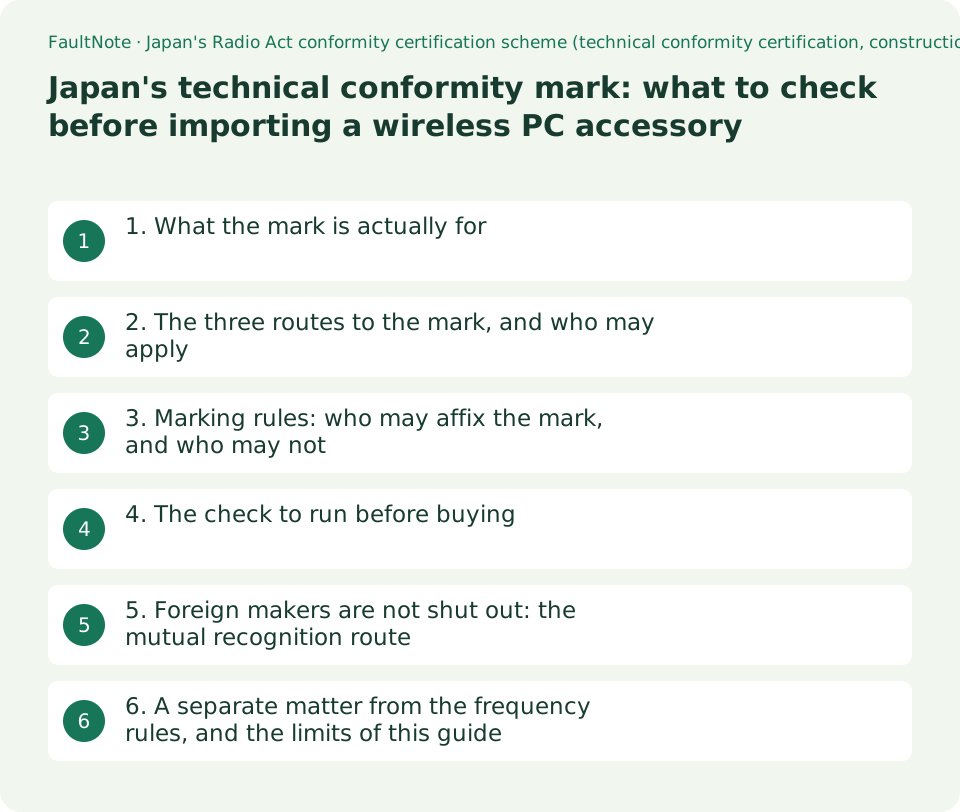
Who this guide is for and what to prepare
- Readers who have found a wireless accessory cheaper overseas and want to know whether it may be used in Japan
- Readers wondering how far to trust a listing that simply claims the mark is present
- Readers about to buy used or parallel-imported wireless equipment
What you need
- Write down the exact model number or name as printed on the packaging or the product page
- Confirm the device has a radio function at all - Wi-Fi, Bluetooth and proprietary 2.4 GHz receivers all count
- Note whether you are buying through ordinary domestic distribution or importing it yourself
1. What the mark is actually for
The ministry's radio-use portal explains that establishing a radio station is in principle subject to licensing, and that conformity of the equipment with the technical standards is inspected as part of the licence application. It then explains that for specified radio equipment, where conformity certification under the Radio Act has been obtained in advance and the mark prescribed by ministerial ordinance is displayed, special measures such as omission of that inspection apply.
So the mark is not a quality or safety label; it is the precondition for a procedural exemption. The reason anyone can use Wi-Fi and Bluetooth without a licence or an operator qualification is this scheme. The portal's wireless LAN page states that equipment meeting the technical standards laid down in the radio regulations, bearing the certification display, may be used by anyone without obtaining a radio operator qualification or a station licence.
The same page carries the sentence this guide starts from: equipment without the technical conformity mark cannot be used within Japan. That is the constraint you meet first when a wireless device looks cheaper overseas.
Scroll horizontally to see the full table →
| Position | What the portal states | What it means for you |
|---|---|---|
| The principle | Establishing a radio station is in principle subject to licensing, with conformity inspected during the licence application | Without the scheme, each device would need its own procedure |
| The exemption | Specified radio equipment that has obtained conformity certification and bears the prescribed mark receives special measures such as omission of the inspection | The mark is a procedural precondition, not a quality certificate |
| Licence-free use | Equipment meeting the technical standards and bearing the certification display may be used by anyone without a qualification or licence | Why you can plug in Wi-Fi and Bluetooth with no paperwork |
| Where it fails | Equipment without the mark cannot be used within Japan | The reason to check before ordering from abroad |
2. The three routes to the mark, and who may apply
There are three routes. Technical conformity certification (Radio Act Article 38-6) has a registered certification body judge conformity for each individual unit of specified radio equipment, and the portal states that anyone may apply for it.
Construction design certification (Article 38-24) covers not the equipment itself but the design drawings and the quality-control method used in manufacturing and handling; the actual equipment is manufactured after certification. This is the crucial route for our reader, and the portal is explicit: applications may be made by businesses engaged in manufacturing, selling or importing specified radio equipment, and an ordinary individual cannot request construction design certification for equipment they intend to use themselves.
Self-confirmation of conformity (Article 38-33) lets manufacturers and importers verify conformity themselves for the design of specially specified radio equipment, meaning equipment less likely to cause interference. This route is likewise for businesses, and the FAQ gives a worked example: an amateur radio enthusiast who assembles equipment for personal use from purchased parts cannot file a self-confirmation notification for it.
Scroll horizontally to see the full table →
| Scheme | What is assessed | Who affixes the mark | Who may apply or notify |
|---|---|---|---|
| Technical conformity certification (Art. 38-6) | Conformity of each individual unit of specified radio equipment | The registered certification body | Anyone may apply |
| Construction design certification (Art. 38-24) | The design drawings and the quality-control method at the manufacturing and handling stage | The party holding the certification (a certified handling business) | Businesses engaged in manufacturing, selling or importing. An individual cannot request it for equipment for their own use |
| Self-confirmation of conformity (Art. 38-33) | The design of specially specified radio equipment, verified by the manufacturer or importer | The notifying manufacturer or importer | Those who manufacture or import such equipment repeatedly and continuously as a business |
3. Marking rules: who may affix the mark, and who may not
On display, the portal states that except where the mark is affixed under the Radio Act, the conformity mark cannot be affixed to radio equipment within Japan. The separate page explaining the display method goes further: displaying the mark on equipment that has not obtained certification is prohibited by Article 38-7 paragraph 3 of the Radio Act, and a violator may be subject to a fine of up to 500,000 yen under Article 112 item 1.
The same page also states that a party who carries out modification work on specified radio equipment bearing the display must remove the conformity mark by the method prescribed by ministerial ordinance. That is the point to keep in mind when buying used equipment that may have been modified.
Several display locations are permitted. Besides direct marking in a visible place on the equipment, the mark may be shown on the equipment's own display or on a connected external display. For a screen display the rule is that the mark must be capable of being shown immediately and clearly by a specific operation, and the fact of electronic marking and the method of displaying it must be made clear, for instance in the supplied manual. That is why phones and routers show the mark somewhere in their settings. On size: the requirement used to be a diameter of at least 3 millimetres, but an ordinance effective 8 February 2019 changed it to a requirement that the display be easily identifiable.
Scroll horizontally to see the full table →
| Display method | Basis (certification regulations) | How to check it |
|---|---|---|
| Direct marking on the equipment | Article 8 paragraph 1 item 1 | Look for a visible place on the body. Where marking is difficult or unreasonable, the manual and the packaging or container may carry it instead |
| On the equipment's own display | Article 8 paragraph 1 item 2 | Bring it up from the settings. The display method must be made clear in the manual or equivalent |
| On an external display | Article 8 paragraph 1 item 3 | Permitted only where it can be shown by a wired connection before the equipment first transmits |
| On a product incorporating certified equipment | Radio Act Article 38-7 paragraph 2 | A product containing certified equipment may carry a display identical to the one on that equipment |
4. The check to run before buying
Four steps. First, look for the mark on the unit, its packaging or its settings screen. Where you cannot see the item, look for a photograph of the marking or a statement in the specification section of the listing. Second, search the model number or name in the ministry's database of equipment that has received conformity certification; the portal points to that search and to an accompanying web API.
Third, consider the route by which you are buying. Domestic distribution and personal importing are not the same starting point. The generalisation beyond that is this guide's own editorial arrangement: products sold into the Japanese market have normally been through the scheme, whereas with a personal import the checking falls to you. The regulatory text does not make that generalisation, so lean on the procedure rather than on the rule of thumb.
Fourth, modification. A party who carries out modification work on marked specified radio equipment must remove the conformity mark by the prescribed method. Used or visibly opened equipment is where this matters.
Scroll horizontally to see the full table →
| Step | Where to look | What you conclude |
|---|---|---|
| 1. Unit, packaging, screen display | A visible place on the body, or the settings screen | No display found means you cannot assume it may be used in Japan |
| 2. Search by model or name | The ministry's search of certified equipment | A device that does not come up has no confirmable status under the scheme |
| 3. Purchase route | Domestic distribution, or an overseas shop and personal import | With a personal import, the checking is yours to do |
| 4. Modification | Signs of disassembly or modification | A party who modifies marked equipment must remove the mark |
5. Foreign makers are not shut out: the mutual recognition route
Nothing about the scheme excludes overseas manufacturers. Alongside domestic registered certification bodies, the portal describes approved certification bodies, being foreign parties approved by the minister, and registered foreign conformity assessment bodies, being bodies in countries with which Japan has a mutual recognition agreement that are registered by the joint committee established under that agreement. On the observation date the page listed 16 domestic registered certification bodies and 18 registered foreign conformity assessment bodies.
The FAQ adds a route for the notification side: where a foreign manufacturer has no representative established in Japan, a Japanese importer can file the self-confirmation notification for that equipment. A path for foreign products into legitimate Japanese distribution exists in the rules.
The corollary is the important part. An individual cannot put a device through that path after the fact. Construction design certification is not available to an individual for equipment they will use themselves, and self-confirmation notification is limited to those manufacturing or importing as a business. "Buy it and have it certified afterwards" is not among the options.
Scroll horizontally to see the full table →
| Kind of body | How the portal describes it | Number listed on the observation date |
|---|---|---|
| Registered certification body (Art. 38-2-2) | A domestic party registered by the minister to carry out technical conformity certification | 16 organisations |
| Approved certification body (Art. 38-31) | A foreign party approved by the minister to carry out technical conformity certification | No separate count is given in the list on the page |
| Registered foreign conformity assessment body (MRA Act Art. 29) | A body in a country holding a mutual recognition agreement with Japan, registered by the joint committee established under that agreement | 18 companies, one of which is noted as suspended |
6. A separate matter from the frequency rules, and the limits of this guide
Whether equipment is certified and where its frequency may be used are two different schemes. Wi-Fi at 6 GHz, for example, splits into indoor-only LPI and outdoor-capable VLP power modes with their own operating-location restrictions, however the equipment is certified; this site's guide to Japan's 6 GHz band covers that. Carrying the conformity mark does not mean the device may be used anywhere.
This guide explains the scheme and the checks. It does not rule on whether any particular device or transaction is lawful. On penalties it quotes only what the portal itself states - that displaying the mark on uncertified equipment is prohibited and that a violator may face a fine of up to 500,000 yen - without offering a legal assessment or deciding which conduct amounts to a violation.
Special provisions such as those for equipment brought in by travellers are not covered, because the relevant pages could not be opened while preparing this guide. The Electrical Appliances and Materials Safety Act, known as PSE, is a different scheme entirely, and is not discussed here because the relevant ministry pages could not be retrieved. Do not conflate the two.
Limitations and requirements
- Do not rely on a listing's own claim that the mark is present. The portal states that except where affixed under the Radio Act, the mark cannot be affixed to radio equipment within Japan. Check the physical display and the ministry's search.
- You cannot have a personally imported device certified yourself. Construction design certification is not available to an individual for equipment they will use themselves, and self-confirmation notification is limited to manufacturers and importers.
- Carrying the mark does not mean the device may be used anywhere. Some bands, 6 GHz among them, carry separate operating-location restrictions.
- This guide explains the scheme. It does not judge whether a particular device or transaction is lawful. Where you are unsure, contact the ministry's enquiry desk for the certification scheme.
Frequently asked questions
Does everything sold in Japan carry the mark?
This guide does not offer that generalisation. The procedure is what transfers: look for the display on the unit, the packaging or the settings screen, then search the model number or name in the ministry's database of certified equipment. Products in ordinary domestic distribution will normally pass that check, which is not a reason to skip it.
How do I check a mark that is only shown on screen?
Display on the equipment's own screen and on a connected external display are both permitted routes. In each case the mark must be capable of being shown immediately and clearly by a specific operation, and the display method must be made clear through the supplied manual or an equivalent means. Start by looking in the manual or the settings menu for the section describing how to display the mark.
What about a used wireless device?
Two things. Whether the display is present, on the body or on the settings screen; and whether the device has been modified. The rules state that a party who carries out modification work on marked specified radio equipment must remove the conformity mark by the prescribed method, so a unit showing signs of disassembly or modification is exactly where this becomes a live question.
So foreign-brand equipment cannot be used in Japan?
No. Besides domestic registered certification bodies, the scheme includes foreign bodies approved by the minister and registered foreign conformity assessment bodies under a mutual recognition agreement. The FAQ also notes that where a foreign manufacturer has no representative in Japan, a Japanese importer can file the self-confirmation notification. The question is not whether the brand is foreign but whether that model has been through the scheme.
Sources and verification date
Sources checked: . These sources support the specifications, procedures or prices discussed here. Check each source for applicable conditions and current information.
- MIC radio-use portal: outline of the conformity certification scheme (with the list of registered certification bodies). The licensing principle and the exemption for specified radio equipment, definitions and article numbers for the three routes, who affixes the mark, the display provisions, the lists of 16 domestic bodies and 18 registered foreign conformity assessment bodies, and the pointers to the equipment search and its web API. Read 2026-09-20 ↗
- MIC radio-use portal: how the conformity mark is displayed. The prohibition on marking uncertified equipment and the associated fine, who may affix the mark, the 2019 ordinance change to the size requirement, and the four permitted display methods. Read 2026-09-20 ↗
- MIC radio-use portal: frequently asked questions about the certification scheme. The answer on importing equipment for domestic sale, the scope of who may file a self-confirmation notification, and the provision for a Japanese importer to notify on behalf of a foreign manufacturer without a representative in Japan. Read 2026-09-20 ↗
- MIC radio-use portal: low-power data communication systems (wireless LAN and similar). The conditions for licence-free use, the statement that equipment without the mark cannot be used within Japan, and the per-band operating-location restrictions. Read 2026-09-20 ↗
- MIC: search of equipment that has received technical conformity certification, the entry point for checking a model number or name. Reachability confirmed 2026-09-20 ↗
Related practical guides
- USB vs PCIe Wi-Fi Adapter: Check Installation Requirements, Bluetooth and Speed Labels Before Buying
- Connecting a Game Controller to a PC: USB Cable vs Bluetooth vs Xbox Wireless Adapter
- Adding Bluetooth to a desktop PC: reading a USB adapter's version number, placement and limits
- Japan's 6 GHz Wi-Fi rules: how many 320 MHz channels, and which devices may go outdoors
- CMR vs. SMR Hard Drives: Tell Them Apart by Model Number for NAS, RAID and Backup
- PC Headset Connections: USB, 3.5 mm, 2.4 GHz Dongle or Bluetooth, and What Happens to the Microphone