How to read printer page yield: cartridges, ink tanks and laser under the ISO test conditions
The hard part of buying a printer is not the price of the unit but the consumables that follow. The "page yield" on a spec sheet is not an impression; it is a figure measured to an international standard. Epson's measurement conditions page states that yield for colour inkjet output follows ISO/IEC 24711 (method) and ISO/IEC 24712 (test images), that mono document cost follows ISO/IEC 19752, and that page printer (laser) yields are calculated to JIS X 6932 (ISO/IEC 19798) or JIS X 6931 (ISO/IEC 19752). A shared assumption runs through all of them: the figure is calculated with a replacement cartridge or ink bottle, not the one supplied for initial setup. Yet for its EcoTank models Epson notes that the yield is "a simulated value calculated independently by Epson using the ISO/IEC 24712 test images" and that it "does not comply with ISO/IEC 24711 (the measurement standard)". Two "cost per page" figures may therefore not be measured the same way at all. This guide ties the standards and the footnotes to concrete published numbers.
Published · Updated · FaultNote editorial policy
Who this guide is for and what to prepare
- People replacing a home printer who want to compare ink cost, not just the purchase price
- People deciding between a high-capacity ink tank model, a cartridge model and a laser printer for their own print volume
- People who want to know what conditions produced the "page yield" and "cost per page" numbers in a catalogue
What you need
- A rough annual breakdown of your printing: mono documents, colour documents and photos, and how many pages you print in one go
- The specification page and the consumables page for each candidate (not only ink or toner, but drum, belt and waste toner units with their published page counts)
- The manufacturer's measurement-conditions page, where the standard used and the date and source of the prices are stated
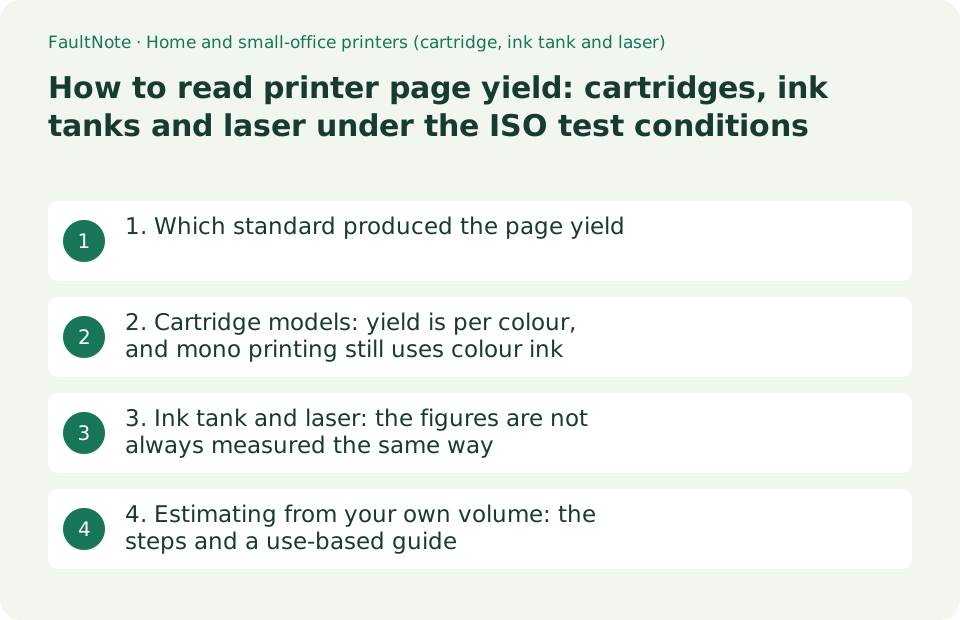
1. Which standard produced the page yield
Page yield is not a number each maker invents; it is measured with standardised documents and procedures. Epson's measurement conditions page (in Japanese) states that colour inkjet yield is calculated in accordance with the international standards ISO/IEC 24711 (measurement method) and ISO/IEC 24712 (test images), that mono document cost follows ISO/IEC 19752, and that L-size photo cost follows ISO/IEC 29102 (method) and ISO/IEC 29103 (images). It also states that the cost calculation as a whole follows the JEITA guideline on displaying printing costs for household inkjet printers.
Laser printers use different standards. In the page-printer section of the same document, colour models are calculated to JIS X 6932 (ISO/IEC 19798) and mono models to JIS X 6931 (ISO/IEC 19752), "from the number of pages a toner cartridge can print when printing continuously on one side of A4 plain paper". Brother likewise states on the consumables page for its colour laser multifunction devices that toner page yields are calculated to JIS X 6932 (ISO/IEC 19798). Inkjet and laser page counts are therefore different numbers measured to different standards.
Two assumptions are common to all of them. The first is continuous printing. The second is Epson's note that the calculation uses "the replacement ink cartridge or ink bottle used from the second time onwards, not the ink cartridge or ink bottle used at initial setup". The ink that comes in the box is partly consumed filling the print head to the nozzle tips, which Epson also notes on individual product pages as a reason the first cartridge prints fewer pages.
Brother's inkjet FAQ (published 25 August 2019, updated 6 April 2026) explains that the remaining page count shown on the printer can be calculated two ways. "ISO conversion" is based on the documents and settings defined in the general document yield standard ISO/IEC 24711, and Brother states that "if the conditions you use day to day do not match the conditions defined by ISO, the calculated number and the number you can actually print may differ greatly" and that the figure should be used as a reference value. The alternative, "consumption conversion", is based on how much ink your own printing has actually used.
Scroll horizontally to see the full table →
| What is measured | Standard cited by the maker | Shared assumption |
|---|---|---|
| Ink cartridge (colour documents) | ISO/IEC 24711 (method) with ISO/IEC 24712 (images) | A4 plain paper, continuous printing, calculated with a replacement cartridge |
| Ink cartridge (mono documents) | ISO/IEC 19752 | As above |
| Photos (L size) | ISO/IEC 29102 (method) with ISO/IEC 29103 (images) | Photo paper. Since August 2012 Epson displays ISO-based figures rather than JBMS-77/78 |
| Colour laser toner | JIS X 6932 (ISO/IEC 19798) | Continuous single-sided printing on A4 plain paper |
| Mono laser toner | JIS X 6931 (ISO/IEC 19752) | As above |
| Remaining pages shown on the printer (Brother) | ISO conversion (ISO/IEC 24711 documents and settings) or consumption conversion | Brother calls the ISO figure an approximation to be used as a reference value |
2. Cartridge models: yield is per colour, and mono printing still uses colour ink
The detail most often missed on a cartridge printer is that page yield is stated per colour. Epson publishes a table of yields by model and cartridge part number. For the KNI series used by the EP-887A, black is 667 pages while cyan, magenta, yellow, light cyan and light magenta are 155 pages each; for the high-capacity KNI-L series it is 1,130 pages for black and 393 for each colour. Brother's FAQ describes the ISO five-page A4 document as one in which "text and images are moderately mixed in monochrome and colour", so with a test document that uses colour, black lasts disproportionately long.
"I only print in mono but the colour ink still drains" also has a documented explanation. Brother's FAQ notes that "to maintain print quality and protect the print head, ink of every colour is used for cleaning; because this consumes ink, the printable page count decreases after cleaning". Epson's measurement conditions page likewise states that "to protect the head and maintain print quality, each colour of ink is consumed periodically before and during printing". An inkjet printer consumes ink even across periods when you do not print.
Brother's description of consumption conversion spells out the effect of your own documents: printing many pages with large printed areas shows fewer remaining pages than the ISO conversion, printing many pages with small printed areas shows more, and printing many documents that lean on one colour reduces that colour's remaining pages sharply. The catalogue figure is a baseline, not a forecast of your own results.
Published per-page costs are conditional too. Epson's EP-887A specification page lists A4 colour document ink cost as about 14.8 yen including tax with the high-capacity KNI cartridges, and L-size photo ink-plus-paper cost as about 26.2 yen with high-capacity cartridges or about 33.7 yen with standard ones. The measurement conditions page states these were calculated from the yields above and the tax-included prices listed in the Epson Direct Shop as of 1 July 2026. They are not shop prices and not current prices.
Scroll horizontally to see the full table →
| What to check | Epson's published figure | How to read it |
|---|---|---|
| Per-colour yield (EP-887A, KNI series) | 667 pages black, 155 pages each colour | For colour documents the replacement interval is set by the colour figure |
| High-capacity cartridges (KNI-L) | 1,130 pages black, 393 pages each colour | Roughly 2.5 times the colour yield; the L in the part number changes the assumption |
| A4 colour document ink cost (EP-887A) | About 14.8 yen including tax with high-capacity cartridges | Calculated from Epson Direct Shop prices as of 1 July 2026 |
| L-size photo, ink plus paper (EP-887A) | About 26.2 yen (high capacity) or 33.7 yen (standard) | This figure includes paper; the document cost figures do not |
| The cartridges in the box | Initial setup cartridges | Part of the ink fills the head, so they may print fewer pages than a replacement |
| Periods without printing | Every colour is consumed periodically to protect the head | Ink drains even with light use (noted by both Epson and Brother) |
3. Ink tank and laser: the figures are not always measured the same way
High-capacity ink tank models make cost per page look an order of magnitude lower. Epson's page for the EcoTank EP-M476T lists A4 document printing cost as about 0.3 yen mono and about 0.9 yen colour, including tax, and L-size photo ink-plus-paper cost as about 8.2 yen. Next to the EP-887A's roughly 14.8 yen for colour, the gap is obvious.
The footnotes differ, though. Epson's measurement conditions page states for EcoTank colour cost that the yield is "a simulated value calculated independently by Epson using the ISO/IEC 24712 test images (cyan, magenta and yellow are a combined average)" and that it "does not comply with ISO/IEC 24711 (the measurement standard)". The mono figure is likewise described as an independent simulation using the ISO/IEC 19752 images. Cartridge figures follow ISO/IEC 24711; the ink tank figures explicitly do not. That is worth knowing before putting the two numbers side by side.
The hardware conditions are worth comparing too. The EP-M476T page gives a durability (product life) of 30,000 A4 pages or five years and a warranty period of one year (carry-in repair), with a note that the warranty ends if the model's specified page count is reached within the warranty period. A low cost per page still sits under a ceiling on the machine itself.
On a laser printer, toner is not the only consumable. Brother's consumables page for the MFC-L3780CDW (read on 19 September 2026) lists the standard TN299 colour toners at about 1,200 pages, the high-yield TN299XL at about 2,300 pages colour and 3,000 black, and the super high-yield TN299XXL at about 4,000 pages colour and 4,500 black, all as A4 figures published to JIS X 6932. It also lists the DR299CL drum unit at about 20,000 pages "when printing one page per job", the WT229CL waste toner box at about 50,000 pages "when printing five pages per job" and the BU229CL belt unit at about 50,000 pages "when printing two pages per job". The conditions attached to the page counts differ per part.
Brother adds on the same page that "toner life may be shortened when print density is low or when the power is switched on and off frequently, and in that case several colours of toner may reach the end of their life at the same time". Epson states as a condition of its page-printer running costs that intermittent printing (jobs of one to a few pages), paper size and orientation, thick paper, the original document, the number of transitions to power-saving mode and frequent power cycling all reduce the printable page count, so that "depending on your conditions and environment the printable page count may be half or less". Printing a little at a time is the furthest use from the conditions behind the catalogue.
Scroll horizontally to see the full table →
| Type | Manufacturer figure (read 19 September 2026) | The footnote that matters |
|---|---|---|
| Cartridge model (EP-887A) | A4 colour document about 14.8 yen (high capacity, incl. tax) | ISO/IEC 24711 and 24712; calculated from Epson's own shop prices as of 1 July 2026 |
| Ink tank model (EP-M476T) | A4 mono about 0.3 yen, colour about 0.9 yen (incl. tax) | An Epson simulation using ISO/IEC 24712 images; explicitly not compliant with ISO/IEC 24711 |
| Ink tank hardware limits (EP-M476T) | Durability 30,000 pages or five years; one-year warranty | The warranty ends if the specified page count is reached |
| Colour laser toner (TN299 series) | About 1,200 pages standard; 2,300 colour and 3,000 black high yield; 4,000 colour and 4,500 black super high yield | A4 figures published to JIS X 6932 (ISO/IEC 19798) |
| Laser parts other than toner | Drum about 20,000 pages, waste toner about 50,000, belt about 50,000 | Different conditions: one page per job for the drum, five for the waste toner, two for the belt |
| Printing a little at a time | — | Brother: frequent power cycling shortens toner life. Epson: intermittent printing can halve the page count or worse |
4. Estimating from your own volume: the steps and a use-based guide
The procedure is simple. First, count your annual pages split into mono documents, colour documents and photos. Second, divide by the per-colour yields of each candidate (Epson's yield table for cartridge models, the JIS X 6932 figures on the consumables page for laser) to get replacements per year. Third, use the maker's per-page cost where one is published under stated conditions, and otherwise check consumable prices yourself and multiply. Fourth, for laser, convert the drum, belt and waste toner intervals into years and add them, remembering that each part's page count has its own condition.
What decides the outcome is how many pages you print per job. As both Epson and Brother note, printing one to a few pages at a time and switching the printer on and off often will not reach the published counts. The catalogue figures are measured under continuous printing, so the more you batch your printing, the closer you land to them.
If photos dominate, read the L-size row rather than the document row. Epson's product pages give an "ink plus paper total cost" for L-size, which includes paper, while the document figures exclude it, and the standards behind them are ISO/IEC 29102 and 29103 rather than the document standards. Check which row includes what even within one page.
If you print very rarely, the technology itself works against you in two different ways: inkjets consume ink periodically to protect the head, and lasers struggle to reach their published page counts under repeated small jobs. In that case it is worth comparing against alternatives such as printing at a convenience store. This article does not cover prices, so run that comparison with prices you have checked yourself.
Scroll horizontally to see the full table →
| How you print | Type that fits | What to verify in the estimate |
|---|---|---|
| Several hundred pages a year, mostly mono documents | Mono laser, or a high-capacity tank model | The JIS X 6931 (ISO/IEC 19752) figure and whether separate parts such as a drum are needed |
| Colour documents printed in batches | Colour laser or an ink tank model | Colour toner page counts (JIS X 6932) and the drum, belt and waste toner intervals |
| Mostly photos (L size or A4) | A photo-oriented inkjet | The L-size "ink plus paper" cost and the ISO/IEC 29102 and 29103 basis |
| Occasional small jobs | Reconsider the workflow rather than the type | Both makers' notes that intermittent printing misses the published counts |
| Colour documents every day | Ink tank or laser | Per-colour yields (on a cartridge printer the colours run out first) |
| Want the machine to last | A model that publishes a durability figure | EP-M476T example: 30,000 pages or five years, with the warranty ending at the page limit |
Limitations and requirements
- All page counts and costs here are manufacturer figures. Epson's per-page costs were calculated by Epson from its own measurement conditions and the prices listed in its own shop (stated as of 1 July 2026 in the inkjet section and 3 July 2023 in the page printer section); they are not current retail prices. This site did not observe any prices.
- Figures measured differently do not mean the same thing side by side. Epson states explicitly that EcoTank yields do not comply with ISO/IEC 24711. When comparing a standard-compliant figure with an independently calculated one, keep that difference in view.
- This article does not cover prices, stock or rankings. The models and part numbers named are examples that make the published figures readable, not a recommendation order. The specifications are those published on 19 September 2026.
Frequently asked questions
Why can I not print as many pages as the catalogue says?
Because the catalogue value is a baseline measured with standardised documents and conditions: A4 plain paper, continuous printing and a replacement cartridge. Brother's FAQ says of the ISO conversion that "if the conditions you use day to day do not match the conditions defined by ISO, the calculated number and the number you can actually print may differ greatly" and that it should be used as a reference value. For laser printers Epson notes that intermittent printing, paper size, thick paper, transitions to power-saving mode and frequent power cycling mean the printable page count "may be half or less depending on your conditions and environment". Printing documents with large printed areas also lands below the published figure.
Why does colour ink drain when I only print in black and white?
The makers describe this as designed behaviour. Brother's FAQ notes that "to maintain print quality and protect the print head, ink of every colour is used for cleaning; because this consumes ink, the printable page count decreases after cleaning". Epson's measurement conditions page states that "to protect the head and maintain print quality, each colour of ink is consumed periodically before and during printing". This is head protection inherent to inkjet printing rather than a fault. If your printing is mostly mono and reasonably high in volume, a mono laser printer belongs in the comparison.
For a laser printer, is toner the only cost to plan for?
No. On a colour laser, other replaceable parts count too. Brother's consumables page for the MFC-L3780CDW lists toner (the TN299 series, from about 1,200 pages standard to about 4,500 pages for super high-yield black, as A4 figures to JIS X 6932) alongside a drum unit at about 20,000 pages, a waste toner box at about 50,000 pages and a belt unit at about 50,000 pages. The conditions differ per part: one page per job for the drum, five pages per job for the waste toner and two pages per job for the belt. Epson likewise explains that page-printer running costs are calculated from the printable pages of consumables including the toner cartridge, the photoconductor and the waste toner box.
Sources and verification date
Sources checked: . These sources support the specifications, procedures or prices discussed here. Check each source for applicable conditions and current information.
- Epson: measurement conditions for printers (ISO/IEC 24711, 24712, 19752, 29102, 29103 and JIS X 6931/6932, in Japanese) ↗
- Epson: yield (printable pages per colour) by printer and cartridge, in Japanese ↗
- Epson: Colorio EP-887A specifications (A4 colour document ink cost, L-size total cost, in Japanese) ↗
- Epson: EcoTank EP-M476T specifications (printing cost, durability of 30,000 pages or five years, in Japanese) ↗
- Brother: how inkjet printable pages are calculated (ISO conversion and consumption conversion, updated 6 April 2026, in Japanese) ↗
- Brother: MFC-L3780CDW consumables and options (published page counts for toner, drum, belt and waste toner, in Japanese) ↗
Related practical guides
- Check PC-Part Compatibility Before Buying: CPU, BIOS, RAM, Case and Power
- Air cooler or AIO? Choose by case clearance, noise and maintenance
- PCIe 4.0 or 5.0 SSD for gaming? Check load times, capacity and slot sharing
- DDR4 vs. DDR5: Choose for a New Build, Reused RAM and Upgrade Cost
- DDR5 with Two or Four DIMMs: Compare Upgrade Speed Limits and Kits
- Integrated vs. Discrete Graphics: Check Workloads, CPU Models and Outputs