Measure Laptop Battery Wear: Reading the Windows Battery Report and Deciding When to Replace
A laptop battery is a consumable part and its capacity falls with use, so the first step is to produce a number. Windows includes powercfg, and Microsoft's documentation says /batteryreport generates a report of battery usage characteristics over the lifetime of the system as an HTML file in the current path. Dell's support library explains that the report shows design capacity, full charge capacity and usage history, and Dell's knowledge base article lists concrete reasons to replace: battery health showing Fair or Poor, a significant reduction in runtime to less than 50% of original capacity, frequent diagnostic error codes, unexpected shutdowns while charge remains, physical swelling or damage, and age exceeding 2-3 years with heavy use. On the prevention side, Microsoft publishes charge limiting (Surface smart charging at 80%, the UEFI Battery Limit at 50%), advice against holding a high state of charge, and an operating range of 0-35°C. This guide walks from the report to the replacement decision.
Published · Updated · FaultNote editorial policy
Who this guide is for and what to prepare
- People whose laptop runtime has dropped and who need to choose between a new battery and a new laptop
- People who want a measured figure for battery wear instead of an impression
- People who keep a laptop plugged in and want settings that slow battery ageing
What you need
- Your model and purchase date, and how much warranty is left (checkable on the manufacturer's support site)
- Access to Command Prompt or Terminal (the report is saved as an HTML file)
- Any power utility from the manufacturer (Dell Power Manager, Dell Optimizer, the Surface app and similar)
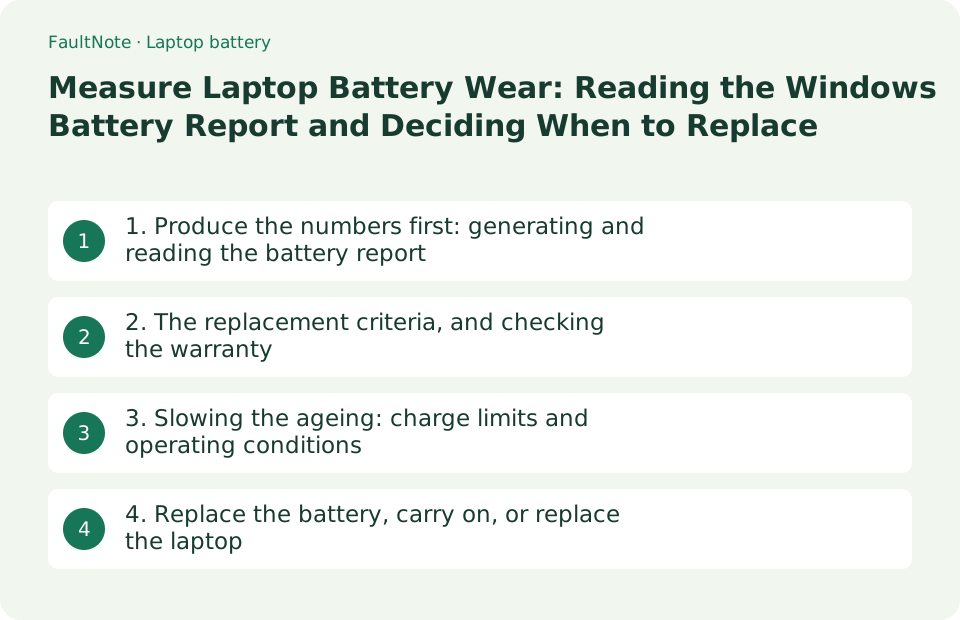
1. Produce the numbers first: generating and reading the battery report
Microsoft's powercfg documentation states that powercfg /batteryreport generates a report of battery usage characteristics over the lifetime of the system and writes an HTML report file to the current path. You can set the destination with /output followed by a file name, add /xml for XML format, or use /duration days to limit how many days are analysed. The same page lists related options such as /energy, which analyses the system for common energy-efficiency and battery life problems, and /sleepstudy for modern standby.
Manufacturer documentation is more specific about reading it. Dell's support library says that running powercfg /batteryreport from Command Prompt creates a detailed HTML report at C:\Users\your-account\battery-report.html and tells you to review details such as design capacity, full charge capacity and usage history, naming Installed battery, Recent usage and Battery usage as good sections to start with. How far full charge capacity has fallen below design capacity is the wear figure people are looking for.
The same Dell page lists what affects battery health: the age of the battery, charge cycles (each full charge and discharge counts as one), extreme heat or cold, usage patterns such as running demanding applications or keeping the laptop plugged in all the time, and power settings and background applications. If the number looks worse than you expected, review those conditions before deciding to replace.
Scroll horizontally to see the full table →
| What to look at | What the documentation says | How to use it |
|---|---|---|
| Generating the report | Microsoft: /batteryreport generates a report of battery usage characteristics over the lifetime of the system, as HTML | Produce it first. /output sets the file name and /duration limits the days analysed |
| Design capacity | Dell: named as one of the details to review in the report | The capacity the battery was designed for. Use it as the baseline |
| Full charge capacity | Dell: named as one of the details to review in the report | What the battery can hold now. The gap from design capacity is the wear |
| Usage history (Installed battery / Recent usage / Battery usage) | Dell: listed as sections to start with | Separates a sudden drop from a gradual decline |
| BIOS and manufacturer apps | Dell: battery health can also be read in BIOS/UEFI, Dell Optimizer, Dell Power Manager and the on-board diagnostics | Cross-check the Windows figure against the manufacturer's own verdict |
2. The replacement criteria, and checking the warranty
Manufacturers publish fairly concrete criteria. Dell's knowledge base article (article number 000124397, last modified on the page as 24 Aug 2026) describes the battery as a consumable part and lists the situations that call for replacement: battery health status showing Fair or Poor, a significant reduction in runtime to less than 50% of original capacity, frequent diagnostic error codes during testing, unexpected shutdowns even when the battery shows charge remaining, physical swelling or damage, and battery age exceeding 2-3 years with heavy use.
Dell also defines what each status word means. Excellent is operating at maximum capacity; Good charges normally but may not last as long as it used to, with long-term life decreasing; Fair charges normally but is nearing the end of its usable life and replacement should be considered soon; Poor no longer provides sufficient power and replacement is recommended; Unknown means the battery no longer operates or its status cannot be determined, and replacement is recommended. Reading these alongside the figures in the Windows report keeps the decision consistent.
Check the warranty before buying anything. Dell explains how to open your product specifications from the Service Tag and look for the battery entry: no special notation in the description means one-year coverage, while a description containing "3 Years Limited Hardware Warranty", LL or Long Cycle Life means three-year coverage. For a swollen battery, Dell says to stop using it immediately, disconnect the AC adapter and not use the battery again, and warns against puncturing, compressing or disassembling it.
Scroll horizontally to see the full table →
| Situation | What Dell states | What to do |
|---|---|---|
| Status is Fair | Charges normally but is nearing the end of its usable life | Plan for a replacement, sooner if you rely on it away from a desk |
| Status is Poor or Unknown | No longer provides sufficient power, or cannot be determined; replacement recommended in both cases | Replace it, checking the warranty first |
| Runtime below 50% of the original | Listed as a reason to consider replacement | Back it up with the full charge capacity against design capacity in the report |
| Shuts down while charge remains | Listed as a reason to consider replacement | Replace before it costs you unsaved work |
| Swelling or physical damage | Stop using it immediately and disconnect the AC adapter; do not puncture, compress or disassemble | Stop using the device on battery and follow the manufacturer's instructions |
| Warranty check | No special notation means one year; "3 Years Limited Hardware Warranty", LL or Long Cycle Life means three years | If it is still covered, contact support before buying a battery |
3. Slowing the ageing: charge limits and operating conditions
Charge limiting is the feature that matters if you work plugged in. Microsoft's Surface support says smart charging is always active and turns on automatically when it detects the device is plugged in for prolonged periods or used at elevated temperatures; while it is on, the battery discharges and limits its maximum charge to 80%, and a heart icon appears over the battery icon in the system tray. If you discharge below 20% or use the battery often, smart charging automatically pauses and allows a full charge, and on supported models the Surface app can pause it manually or set the charging mode to Limit to 80% or Adaptive.
There is a stronger limit as well. Surface UEFI has a Battery Limit option: when it is enabled the battery stops charging at 50% of maximum charge capacity, and if you enable it above 50% the battery does not resume charging until it drops below 50%. Microsoft recommends this setting for devices intended to be always connected to power, such as point of sale, RFID and kiosk scenarios. On a laptop from another maker, look for an equivalent charge threshold in the manufacturer's own utility.
The operating conditions are published too. Microsoft's Surface battery article says devices charged or operated at high temperatures will suffer accelerated ageing and permanent loss of charging capacity, that Surface devices are designed to work between 0°C and 35°C, and to keep the device out of the sun and out of hot cars. It also says batteries maintained at a high charge state lose capacity faster, so avoid leaving the device on AC power for extended periods and try to discharge below 50% before charging again; reduce the charge to about 50% before long-term storage and check it periodically so it does not drain too low; and charge to 100% after unboxing or extended storage to calibrate. Dell adds practical measures: use the original charger, reduce screen brightness, reduce the refresh rate, turn off unused features, and keep BIOS and drivers updated.
Scroll horizontally to see the full table →
| Measure | What the official document states | Who it suits |
|---|---|---|
| Smart charging (Surface) | Microsoft: turns on automatically when plugged in for long periods or used hot, and limits maximum charge to 80%; pauses below 20% | People who mostly work at a desk and travel occasionally |
| Battery Limit (Surface UEFI setting) | Microsoft: charging stops at 50% of maximum charge capacity; recommended for always-plugged-in devices | Machines that stay on AC power almost all the time |
| Temperature | Microsoft: charging or operating hot accelerates ageing; Surface devices are designed for 0-35°C | Everyone (keep it out of hot cars and direct sun) |
| Not sitting at full charge | Microsoft: a high state of charge loses capacity faster; discharge below 50% regularly before recharging | People who leave the laptop on AC power |
| Long-term storage | Microsoft: reduce to about 50% before storing and check periodically that it has not drained very low | A spare machine you will not use for a while |
| Reducing consumption | Dell: use the original charger, lower brightness, lower the refresh rate, turn off unused features, update BIOS and drivers | People who need a little more runtime from one trip |
4. Replace the battery, carry on, or replace the laptop
The decision splits three ways. If the numbers are poor but the machine itself is fine, a new battery is the candidate. Dell states that when the battery is out of warranty you need to buy a new Dell battery, and gives the route: identify the laptop, open Parts & Repairs on its product support page, select Power & Power Supplies and choose the battery. It also notes that availability varies by region and that an on-site technician to fit it may cost extra. Because parts supply differs by model and region, confirm availability before committing to keeping the machine.
Sometimes poor numbers are survivable with a change of habits. If the laptop lives on a desk and only leaves it briefly, setting a charge limit and continuing is a reasonable choice. Unexpected shutdowns or swelling are not: Dell lists both as reasons to replace, and swelling means stopping use of that battery entirely.
Scroll horizontally to see the full table →
| Situation | Decision | Basis and next step |
|---|---|---|
| Full charge capacity far below design capacity, but the machine still performs well | Consider a battery replacement | Dell publishes the purchase route; check regional availability and fitting cost first |
| Status Fair or Poor while still under warranty | Contact support before buying | Dell explains how to tell one-year from three-year battery coverage in the product specifications |
| Almost always on a desk, rarely carried | Set a charge limit and carry on | Microsoft documents smart charging (80%) and the UEFI Battery Limit (50%) |
| Unexpected shutdowns, or visible swelling | Stop and replace | Dell warns to stop using a swollen battery immediately and disconnect the AC adapter |
| No replacement part available, and other complaints too | Consider a new laptop | On the next machine, check the battery warranty term and whether a charge limit feature is documented |
| Poor numbers with no obvious explanation | Review the conditions first | Dell lists age, charge cycles, temperature, usage patterns and power settings as the factors |
Limitations and requirements
- The steps and criteria here are what Microsoft Learn, Microsoft Support (Surface), and Dell's knowledge base article and support library stated on 19 September 2026. The status words and replacement thresholds are Dell's, published for Dell products; other makers report battery health differently. Check the documentation for your own model.
- The charge-limiting features (the 80% limit, the UEFI Battery Limit) are what Microsoft publishes for Surface devices. Supported models and menu locations differ, and Microsoft itself notes that not all Surface devices have options to manage smart charging.
- This site did not generate a battery report or measure a capacity on any device. The command syntax and the decision criteria quoted here come from published manufacturer documentation, and prices, stock and repair costs are out of scope.
Frequently asked questions
Does leaving the laptop on the charger wear the battery out faster?
Microsoft says batteries maintained at a high state of charge lose capacity faster, and recommends not leaving the device connected to AC power for extended periods but instead discharging below 50% regularly before charging again. For cases where the device genuinely has to stay plugged in, it points to the UEFI Battery Limit setting, which stops charging at 50%. Surface smart charging works on the same idea, switching to an 80% limit automatically when it detects prolonged AC use or elevated temperatures.
How far below design capacity is far enough to replace?
The figure manufacturers commit to is about runtime. Dell lists a significant reduction in runtime to less than 50% of original capacity as one reason to replace, alongside a battery health status of Fair or Poor. Use the ratio of full charge capacity to design capacity in the report as supporting evidence and cross-check it against the status shown in BIOS or the manufacturer's app.
The bottom of my laptop is bulging. Can I keep using it for now?
No. Dell says that if you suspect swelling you should stop using the battery immediately, disconnect the AC adapter, let the battery drain completely and not attempt to use that battery again, and warns against puncturing, compressing or disassembling a swollen battery and against keeping it near heat sources. Arrange the replacement through the manufacturer's stated route.
Sources and verification date
Sources checked: . These sources support the specifications, procedures or prices discussed here. Check each source for applicable conditions and current information.
- Microsoft Learn: Powercfg command-line options (/batteryreport, /energy, /sleepstudy) ↗
- Dell: Check Laptop Battery Health (generating the report, what to review, status definitions, ageing factors) ↗
- Dell: How to Check Battery Health Status on Dell Laptops (article 000124397, last modified 24 Aug 2026) ↗
- Microsoft Support: Smart charging on Surface ↗
- Microsoft Support: Caring for your Surface battery ↗
- Microsoft Learn: Surface Battery Limit setting (a 50% cap in UEFI) ↗
Related practical guides
- Check PC-Part Compatibility Before Buying: CPU, BIOS, RAM, Case and Power
- Air cooler or AIO? Choose by case clearance, noise and maintenance
- PCIe 4.0 or 5.0 SSD for gaming? Check load times, capacity and slot sharing
- DDR4 vs. DDR5: Choose for a New Build, Reused RAM and Upgrade Cost
- DDR5 with Two or Four DIMMs: Compare Upgrade Speed Limits and Kits
- Integrated vs. Discrete Graphics: Check Workloads, CPU Models and Outputs