Monitor Color Gamut Explained: sRGB and DCI-P3 Coverage vs Area Ratio for Photo and Video Editing
A monitor's gamut percentage means different things depending on whether it is coverage (how much of a standard's color range the monitor reproduces) or a ratio (the monitor's gamut area relative to the standard's). EIZO explains that a monitor can be 100% by area ratio yet often below 100% coverage, and that coverage is the practical figure. EIZO also says a wider gamut is not automatically better picture quality: if you work with sRGB content, the standard for Windows and websites, check for a gamut conversion feature such as an sRGB mode. Before buying, check whether the figure is coverage or a ratio, whether there is a preset for your target standard, and, if you plan to use Windows auto color management, whether the display meets its conditions.
Published · Updated · FaultNote editorial policy
Who this guide is for and what to prepare
- People choosing a monitor for photo, video or illustration work by comparing sRGB and DCI-P3 figures
- People whose wide-gamut monitor makes websites and everyday apps look oversaturated and who want to know which setting or spec to check
What you need
- The exact model number of each candidate monitor and the maker's Tech Specs page
- Where your work ends up (web and social media, ordinary photo prints, a video delivery standard, and so on)
- On Windows 11, access to Settings > System > Display
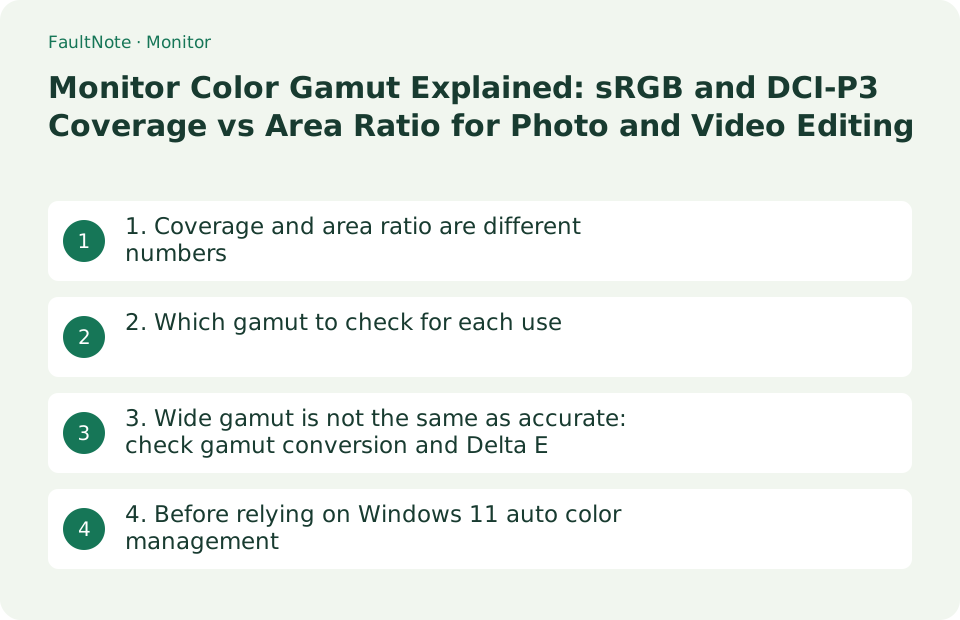
1. Coverage and area ratio are different numbers
Standards such as sRGB, Adobe RGB and DCI-P3 each define a color range (gamut) as a triangle on a chromaticity diagram. Percentages on monitor spec sheets are either coverage, the share of the standard's triangle that the monitor can reproduce, or a ratio, the area of the monitor's gamut relative to the standard's triangle.
EIZO explains that an area-ratio figure such as "Adobe RGB ratio x%" cannot tell you whether part of the monitor's gamut is shifted away from the standard. It notes that a monitor at "100% Adobe RGB ratio" is often below 100% in coverage, and that coverage is the practical figure, so do not compare the size of the number alone. The EIZO explanation is a November 2008 article with product examples from that time, but its description of coverage versus ratio still applies when reading current spec sheets.
Scroll horizontally to see the full table →
| How the spec is written | Meaning | Check before buying |
|---|---|---|
| "sRGB coverage 100%", "Adobe RGB coverage 99%" and similar | The share of the standard's gamut that the monitor reproduces | Check that the standard name matches your target and that the figure is coverage |
| "NTSC ratio x%","Adobe RGB ratio 100%" and similar | The monitor's gamut area relative to the standard's gamut | Even 100% does not guarantee every color of the standard. Look for a coverage figure |
| Only "95% DCI-P3" or "sRGB 100%" | The spec page may not say whether it is coverage or a ratio | Check the maker's datasheet or manual, or ask the maker, which figure it is |
2. Which gamut to check for each use
EIZO describes sRGB as the color space that is the standard for Windows and says websites are made to sRGB. For photos shared online or printed at ordinary photo print shops, it says working in sRGB keeps the gap between screen and result small. For data that uses the wider Adobe RGB gamut, high-quality commercial printing and video production, a wide gamut that matches the output standard becomes important.
The table below starts from where your work ends up. A client's or platform's specified standard takes priority. The figures here are examples of where to look in a spec sheet, not recommended thresholds.
Scroll horizontally to see the full table →
| Main use or output | Standard to check first | What to check on the monitor |
|---|---|---|
| Photos and illustrations for the web and social media, everyday office work and browsing | sRGB | sRGB coverage and whether it has an sRGB mode (a preset that matches the gamut) |
| Photos shot and edited in Adobe RGB for high-quality printing | Adobe RGB | Adobe RGB coverage and whether it can also switch to sRGB |
| Video editing and delivery | The standard specified for delivery (Rec.709, DCI-P3 and so on) | Coverage of that standard and whether a preset with that name exists |
| Mostly games and watching video | Personal preference rather than matching a standard | Even on a wide-gamut model, an sRGB mode makes the web and everyday apps easier to match |
3. Wide gamut is not the same as accurate: check gamut conversion and Delta E
EIZO explains that a wide gamut does not automatically mean high picture quality. Images made for sRGB can look more saturated than intended when shown as-is on a wide-gamut monitor, so EIZO recommends checking for a gamut conversion feature that matches the display to a target gamut such as sRGB or Adobe RGB. For example, a monitor with high Adobe RGB coverage keeps displayed colors inside the sRGB gamut when you select its sRGB mode in the adjustment menu.
As a real spec example, ASUS's US page for the ProArt Display PA278CGV lists "95% DCI-P3", "Color Accuracy ΔE < 2" and "Calman Verified" in the product description, "Color Space (sRGB) : 100%" in the specifications, and ProArt Presets including sRGB, Adobe RGB, DCI-P3, Rec.709 and Rec.2020. However, the page alone does not say whether 95% or 100% is coverage or an area ratio. Delta E indicates how small the color difference is; also check the maker's documents for the conditions under which it was measured.
Scroll horizontally to see the full table →
| Spec or feature | What the PA278CGV page states (US) | How to read it |
|---|---|---|
| Gamut percentage | 95% DCI-P3, Color Space (sRGB) : 100% | Not stated as coverage or ratio. Check the manual or ask ASUS if it matters |
| Presets that match a gamut | sRGB, Adobe RGB, DCI-P3, Rec.709, Rec.2020, DICOM, HDR, User mode1 and 2, Native | Check for a preset named after your output standard. Preset accuracy cannot be judged from the name alone |
| Color accuracy | Color Accuracy ΔE < 2, Calman Verified | Check the documents for measurement conditions (which mode and which standard) |
4. Before relying on Windows 11 auto color management
Microsoft describes Windows auto color management as system-level color management that makes colors across Windows apps appear accurately and consistently on supported displays, whether or not the apps are color-managed. It says that even on displays that only support 8-bit color, it improves color quality with techniques such as dithering.
To turn it on, select Start > Settings > System > Display > Color profile, select your display near the top, and turn on Automatically manage color for apps. However, Microsoft Learn's developer documentation says auto color management for SDR displays requires Windows 11, version 22H2 or later and is limited to displays specifically provisioned with a valid profile by the manufacturer or a display calibration provider. Some monitors do not show the setting, so if you are buying with this feature in mind, check that the maker states support.
Scroll horizontally to see the full table →
| What to check | Microsoft's description | If it is unavailable or unclear |
|---|---|---|
| Windows version | Auto color management for SDR displays requires Windows 11, version 22H2 or later | Check that your Windows 11 version is 22H2 or later |
| Whether the display qualifies | SDR displays provisioned with a valid profile by the manufacturer or a display calibration provider | If the setting does not appear, match the gamut on the monitor itself, for example with its sRGB mode |
| Where the setting is | Settings > System > Display > Color profile > Automatically manage color for apps | Adding color profiles and setting a default profile are on the same page |
Limitations and requirements
- The ASUS specifications in this guide were checked on the US page on 13 September 2026. Wording can differ by country and over time, so also check the maker's page for the country where you buy.
- Gamut coverage and Delta E are the maker's published figures; this guide did not measure any monitor. Actual display varies with the unit, settings and age.
- EIZO's gamut explanation was published in November 2008 and its product examples date from then. This guide uses it only for the difference between coverage and area ratio.
Frequently asked questions
Is "sRGB 100%" enough for photo editing?
If your work goes to the web, social media or ordinary photo prints, sRGB is the reference, but check whether that 100% is coverage or an area ratio. EIZO explains that 100% by area ratio is often below 100% coverage. If you print Adobe RGB photos at high quality or a client specifies another standard, also check coverage of that standard.
Is a monitor with a higher DCI-P3 percentage more color accurate?
Not necessarily. EIZO explains that a wide gamut does not mean high picture quality. If you spend a lot of time on sRGB content, check for a gamut conversion feature such as an sRGB mode and under what conditions Delta E is stated.
Windows 11 does not show "Automatically manage color for apps".
According to Microsoft Learn, auto color management for SDR displays requires Windows 11, version 22H2 or later and only applies to displays provisioned with a valid profile by the manufacturer or a calibration provider. If it does not appear, match the gamut on the monitor itself, for example with its sRGB mode.
Sources and verification date
Sources checked: . These sources support the specifications, procedures or prices discussed here. Check each source for applicable conditions and current information.
- EIZO: Understanding LCD color gamut (Japanese, November 2008) ↗
- EIZO: Adobe RGB vs sRGB, choosing a monitor gamut for your use (Japanese) ↗
- ASUS: ProArt Display PA278CGV Tech Specs (US) ↗
- Microsoft Support: Change display brightness and color in Windows ↗
- Microsoft Learn: Use DirectX with Advanced Color on high/standard dynamic range displays ↗
Related practical guides
- VLC: Play Video, Audio, and Network Streams
- HandBrake: Compress Video with a Device Preset
- ScreenToGif: Create a Short Instructional GIF
- Check PC-Part Compatibility Before Buying: CPU, BIOS, RAM, Case and Power
- Air cooler or AIO? Choose by case clearance, noise and maintenance
- PCIe 4.0 or 5.0 SSD for gaming? Check load times, capacity and slot sharing