Reading a laptop's MIL-STD-810 tested claim: revision, methods, conditions, and what the warranty actually covers
A laptop advertised as having passed MIL-STD-810G testing is not a laptop that will survive being dropped. The standard itself states that it does not impose design or test specifications, and no pass or fail certification scheme appears in its bibliographic record. This guide compares what the primary bibliographic source says with an actual maker's published claim, shows which parts of a product page make a comparison possible at all, and explains why having been tested and being repaired under warranty are two separate matters.
Published · Updated · FaultNote editorial policy
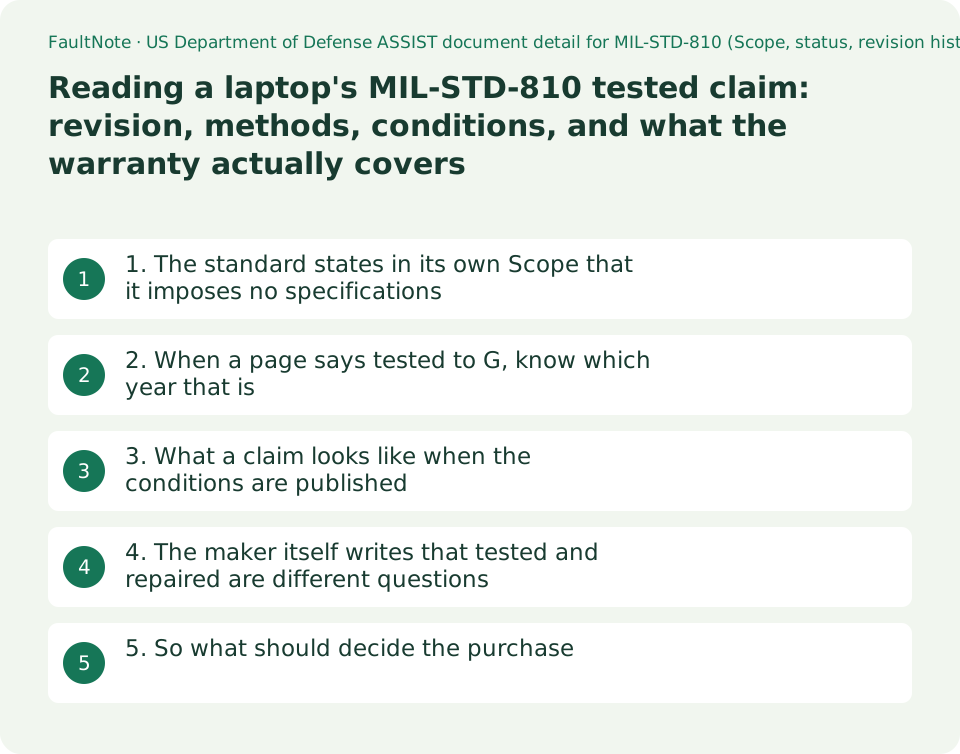
Who this guide is for and what to prepare
- Anyone choosing a laptop to carry daily and wondering whether the durability claim is a usable criterion
- Anyone comparing two makers' military-standard claims and unable to tell which is stronger
- Anyone assuming that a ruggedness claim means drop damage will be repaired under warranty
What you need
- Open both the durability text on the candidate's product page and the footnote attached to it, marked by an asterisk or a note number
- Check whether a revision letter follows the standard name: F, G, G CHG-1 or H
- Open the same maker's warranty and repair terms as well. The durability claim and the warranty conditions live on different pages
1. The standard states in its own Scope that it imposes no specifications
The bibliographic record for MIL-STD-810 is published in ASSIST, the US Department of Defense's official standards document database. The document detail page read on 2026-09-20, which showed Data updated: 18 Sep 2026 near the top, gives the title as Environmental Engineering Considerations and Laboratory Tests. That is considerably narrower than the military standard framing usually found on product pages.
The Scope field reads: "This Standard contains materiel acquisition program planning and engineering direction for considering the influences that environmental stresses have on materiel throughout all phases of its service life. It is important to note that this document does not impose design or test specifications. Rather, it describes the environmental tailoring process that results in realistic materiel designs and test methods based on materiel system performance requirements."
The second sentence is the point. The document does not impose design or test specifications; it describes a tailoring process for building test methods from the performance requirements of the item being tested. A phrase like passed the MIL-STD-810 standard is therefore hard to sustain from the standard's own side.
The same ASSIST record gives Doc Category as Military Standard -Test Method Standard, Status as Active, and Preparing Activity as Army Test and Evaluation Command (ATEC). There is no field on the page corresponding to a certification body that issues a pass result.
2. When a page says tested to G, know which year that is
The same ASSIST page carries a revision history table. As read on 2026-09-20 it listed Revision H Change 1 (change incorporated) at 18-MAY-2022, Revision H at 31-JAN-2019, Revision G Change 1 at 15-APR-2014, Revision G at 31-OCT-2008, and Revision F at 01-JAN-2000, with F followed by three change notices dated 01-NOV-2000, 30-AUG-2002 and 05-MAY-2003.
This is a point that checking corrected. The third-party mirror EverySpec lists H as 01-2019 and F as 05-2003, but in the ASSIST history the current document is dated 18-MAY-2022 as H Change 1, and Revision F itself is 01-JAN-2000. When the vintage of a revision matters, take the dates from the primary side.
So a 2026 product page claiming MIL-STD-810G testing is pointing at the 2008 document, or the 2014 change to it. That is not a defect in itself; a test programme can simply have been built some years ago. But two claims citing different revisions are not figures on a common footing and cannot be lined up as if they were.
A claim with no revision at all, such as meets military standards or military-grade certified, reveals neither which revision nor which guidance was used. Combined with the absence of any pass-fail certification scheme in the record, there is very little to read out of that kind of wording.
Scroll horizontally to see the full table →
| How the product page words it | What you can read from it | What you cannot | What to do next |
|---|---|---|---|
| Military standard or military-grade certified only | Almost nothing; no pass-fail certification scheme appears in the record | Revision, methods, conditions and who tested it | Drop durability from the criteria, or ask the maker to publish the conditions |
| A revision is named, for example MIL-STD-810H | Which revision of the guidance was referenced | Which tests were run, under what conditions, against what pass criteria | Among candidates citing the same revision, look for the next row's detail |
| Revision plus a count of methods, for example 12 methods and 20 procedures | The breadth of the test programme | The severity of each test, and resistance to damage in real use | Look for published numeric conditions per test |
| Revision plus numeric conditions per test | Conditions can be compared with another page that publishes the same test | Behaviour beyond those conditions, and how the warranty treats it | Read the exclusions in the warranty terms, as in section 4 |
3. What a claim looks like when the conditions are published
It is quicker to see what a comparable claim looks like than to describe one. Lenovo's ThinkPad MIL-SPEC page, read on 2026-09-20, stated: "Since 2007, Lenovo has used the US Department of Defense's MIL-STD 810G* standards to help our products strike a perfect balance of value and durability right out of the box." It then stated: "ThinkPad products are currently tested for 12 total methods and 20 procedures".
The page also gives numeric conditions. Humidity is given as "91–98% relative humidity, at 30–60°C", Altitude as "Tested for operations at 15,000 feet", Low Temperature as "Storage: -25°C for 24 hrs. Operation: -21°C for 8 hrs." and High Temperature as "Storage: 63°C for 24 hrs. Operation: 43°C for 8 hrs." With that much published, at least the same named test can be set beside another page's figure.
What the page does not contain is a drop height. The thing a buyer most wants to know, what height the unit was tested from, cannot be read out of this claim. Nothing can be supplied that is not there, so this guide states no drop height either.
The page describes the ThinkPad brand rather than an individual model, and does not say that every model is tested against the same items. Its footer shows a 2017 Lenovo copyright and the marking v1.10 December 2017. As read on 2026-09-20, both the revision cited on it, 810G, and the page's own version marking predate the current H Change 1 of 2022. That is recorded as something a reader can check when meeting such a claim, not as a judgement about the company.
4. The maker itself writes that tested and repaired are different questions
The most practical sentence in this guide comes from a maker's footnote rather than from the standard. The footnote on the Lenovo page reads: "MIL-STD 810G establishes a methodology for testing products against environmental stresses under controlled laboratory conditions. Such testing is not a guarantee of future performance under these test conditions. Abuse, like that contained in MIL-STD 810G testing, is not covered under Lenovo's standard warranty."
The second sentence says the testing is not a guarantee of future performance even under those same test conditions. The third goes further: abuse of the kind contained in the testing is not covered by the standard warranty. Expecting a durability claim to mean that drop damage will be repaired free of charge is contradicted by the footnote on the very page making the claim.
What actually reduces the financial exposure is therefore a different axis: whether a paid service exists that covers accidental damage such as drops and spills. Whether to buy one is not something this guide advises on. The three things to confirm are how long the standard warranty runs, which causes its exclusions list names, and whether a paid service is offered that covers them.
How maker warranties relate to statutory remedies, and how both differ from a shop's initial-defect handling, is covered separately in this site's guide on warranties.
5. So what should decide the purchase
The durability claim does not have to be discarded, but as a comparison tool it is limited. Only when the revision, the count of test items and the numeric conditions are all present can the same named test be set beside another. Few claims carry all three. In preparing this guide only one maker's page was found that published conditions as numbers; a second maker's published wording could not be obtained, which is why no cross-maker comparison of toughness appears anywhere here.
Beyond that, the risks of real use, pressure on the chassis inside a bag, a drink spilling, moving between places with a large temperature swing, do not map neatly onto the names of test methods. Published humidity and altitude conditions say nothing about being compressed inside a rucksack.
A realistic order for checking before purchase is this: is a revision named; are the item count and numeric conditions given; what appears in the exclusions of the warranty terms; is there a paid service covering drops and liquid damage. The first two live on the product page, the last two on the warranty and support pages.
Finally, this guide did not buy the standard. It read the Scope and bibliographic information shown on the ASSIST document detail page, plus the EverySpec entry. It says nothing about the procedure or pass criteria of any individual Method.
Limitations and requirements
- A phrase such as certified to MIL-STD-810 does not sit well with the Scope in the record, which states that the document does not impose design or test specifications. Read maker claims at the level of each company stating that it ran conformance testing.
- No drop height appears in this guide. The maker page read here contains none, and nothing was supplied from elsewhere.
- Only one maker page publishing numeric conditions could be confirmed. There is therefore no cross-maker durability comparison or ranking here of any kind.
- The Lenovo wording quoted is what the page contained when it was read on 2026-09-20. Its footer shows v1.10 December 2017 and the revision it cites is 810G. The page does not state that every model is tested against the same items.
- The standard itself, MIL-STD-810H Change 1, was not obtained. Nothing is said here about the procedures, pass criteria or severity of any Method.
- An implication that military adoption proves toughness does not follow from the Scope, which describes the document as acquisition programme planning and engineering direction.
Frequently asked questions
If one laptop claims 810G and another claims 810H, is the 810H one tougher?
That does not follow. A revision is an update to the guidance, not a severity grade. What the ASSIST history gives is dates only: G in 2008 with Change 1 in 2014, H in 2019, and H Change 1 in 2022. Which is tougher can only be compared by lining up the tests actually performed and their conditions, and that information is published on some product pages and not others.
Is 12 methods and 20 procedures a lot?
This guide does not rate it, because it holds no comparable figure. All that number conveys is breadth, not severity. If you have another maker's page publishing an item count in the same form, compare the item names as well; counts alone mean nothing if the items differ.
If a model advertises ruggedness, will drop damage be repaired free?
The maker footnote read here says the opposite. It states that such testing is not a guarantee of future performance under those test conditions, and that abuse of the kind contained in the testing is not covered by the standard warranty. If drops are your concern, the right things to read are the warranty exclusions and whether a paid service covering drops and spills exists.
Which maker's claim is the most trustworthy?
No ranking is given here. The most that can be said is that some claims carry more readable information than others. A claim with a revision, an item count and numeric conditions is readable; a bare military standard claim is not. That is a difference in how much has been published, not an assessment of reliability.
Can the standard itself be read?
The ASSIST document detail page links to document images, and the bibliographic information and Scope can be read on the page itself. This guide read only the bibliographic record and the Scope, so it does not touch the content of any Method. If the detail of the conditions matters to your decision, asking the maker to publish the specific test conditions may be faster.
Sources and verification date
Sources checked: . These sources support the specifications, procedures or prices discussed here. Check each source for applicable conditions and current information.
- US DoD ASSIST: MIL-STD-810 document detail. Title given as Environmental Engineering Considerations and Laboratory Tests; Scope contains "this document does not impose design or test specifications"; Status: Active; revision history lists Revision H Change 1 at 18-MAY-2022. Read 2026-09-20, page showing Data updated: 18 Sep 2026 ↗
- EverySpec: MIL-STD-810H bibliographic entry, a third-party mirror of US government documents, listing the 810 revisions. Statements needing a primary source are cited to ASSIST instead. Read 2026-09-20 ↗
- Lenovo: ThinkPad MIL-SPEC Testing. "ThinkPad products are currently tested for 12 total methods and 20 procedures", the per-test conditions, and the footnote "Abuse, like that contained in MIL-STD 810G testing, is not covered under Lenovo's standard warranty." Footer marked v1.10 December 2017. Read 2026-09-20 ↗
Related practical guides
- Before buying a laptop with built-in LTE or 5G: checking for the Cellular page in Windows
- USB vs PCIe Wi-Fi Adapter: Check Installation Requirements, Bluetooth and Speed Labels Before Buying
- USB-C Monitor Not Working or Stuck at a Low Refresh Rate: Check DP Alt Mode and Lane Allocation
- Measure Laptop Battery Wear: Reading the Windows Battery Report and Deciding When to Replace
- Single-cable USB-C monitors: match the monitor's supply wattage against your laptop's rating
- Check a laptop's upgradeability before you buy: soldered memory, M.2 slot count and battery capacity