There are two kinds of PSU "Gold": what 80 PLUS and Cybenetics measure, and what neither of them measures
PC power supplies are sold as Gold or Platinum. Those are efficiency certification tiers, but the same tier name means different things depending on which body issued it and under which criteria. 80 PLUS covers conversion efficiency and power factor at stated percentages of rated load (5%, 10%, 20%, 50%, 100%), with a separate table per input-voltage category. Cybenetics is a different body running separate certifications: ETA for efficiency and LAMBDA for noise, where an ETA tier is decided by an overall efficiency derived from more than 1,450 load combinations. A "Cybenetics GOLD" and an "80 PLUS Gold" are therefore not the same claim. This guide reads both bodies' criteria pages on 2026-09-20 and sets out the tier tables, the properties neither certification covers, and a formula for working out your own electricity difference. This site has not tested any power supply, ranks no product and quotes no price.
Published · Updated · FaultNote editorial policy
Who this guide is for and what to prepare
- Anyone choosing between a Bronze and a Gold unit who wants to know what the tier actually guarantees
- Anyone who has seen an unfamiliar label such as "Cybenetics Gold" or "ETA-A" and wants its basis
- Anyone buying a higher tier in the hope that it will be quieter
What you need
- Note the exact model of each candidate power supply and the certification marks printed on it (the issuing body as well as the tier)
- Form a rough idea of your PC's power draw from the published figures of its components (this site supplies no measured figures)
- Look up your own electricity tariff per kWh on your bill or your supplier's account page
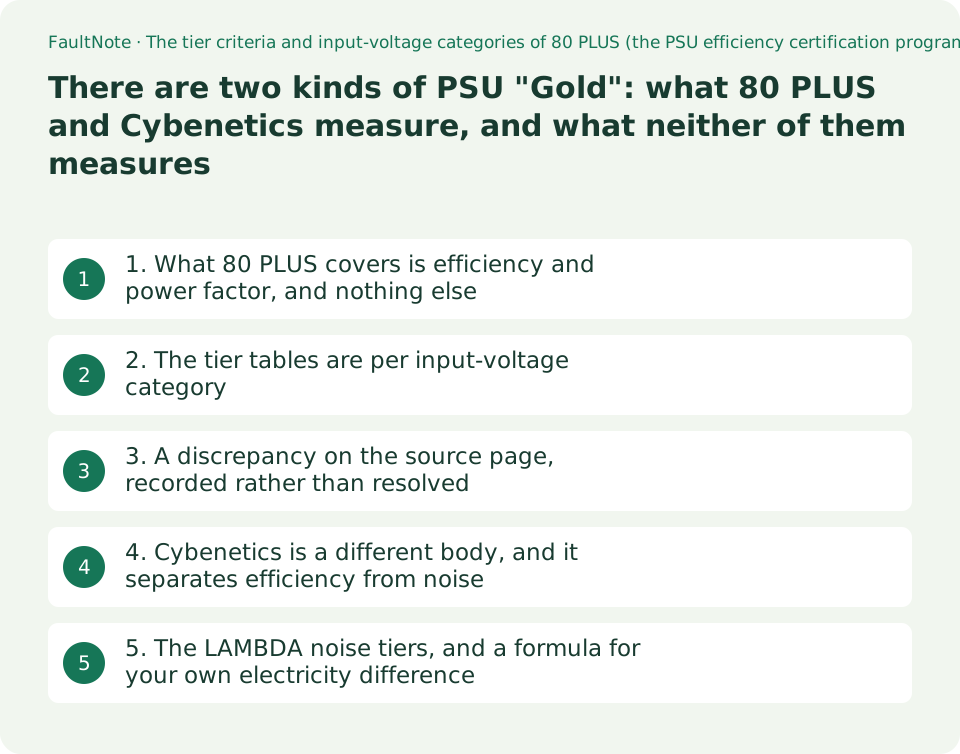
1. What 80 PLUS covers is efficiency and power factor, and nothing else
80 PLUS is a performance specification and certification programme for internal power supply units run by CLEAResult. Its programme page states: "80 PLUS ® is a performance specification and certification program for internal power supply units (PSUs)." and describes the requirement as "Its performance specification requires power supplies in computers and servers to be 80% energy efficient or greater at 10%, 20%, 50% and 100% of rated load with a true power factor of 0.9 or higher." Efficiency at percentages of rated load, plus true power factor.
What follows directly is only this: a higher tier draws less input power for the same output. Noise, service life, failure rate and the quality of the protection circuitry are not quantities this specification addresses.
The same page states that certification costs money: "Depending on the product, the price for testing and certification can range from $3,500 to $8,000 USD." That is part of why some inexpensive units carry no mark — but the absence of a mark does not by itself establish poor efficiency or poor quality, and this guide does not claim that it does.
2. The tier tables are per input-voltage category
The programme page lists the certification categories as 115V Internal desktop, 230V EU Internal desktop, 115V Industrial and 230V Internal Redundant AC data center. For a home desktop, the first two are the relevant ones.
This matters if your mains voltage is neither. The published input-voltage categories on the pages read here are 115V and 230V (plus the data-centre and industrial categories); a 100V category — Japan's ordinary household supply — appears nowhere on them. This guide therefore says nothing about what a unit achieves at 100V, in either direction, and treats the tables as a basis for comparing tiers rather than as measured values for an arbitrary mains supply.
The table below is the desktop, workstation and non-redundant server criteria, transcribed from the ratings page as displayed on 2026-09-20.
Scroll horizontally to see the full table →
| Tier | 115V internal non-redundant: 10% / 20% / 50% / 100% load | 230V EU internal non-redundant: 10% / 20% / 50% / 100% load |
|---|---|---|
| 80 PLUS Standard | – / 80% / 80% / 80% | – / 82% / 85% / 82% |
| 80 PLUS Bronze | – / 82% / 85% / 82% | – / 85% / 88% / 85% |
| 80 PLUS Silver | – / 85% / 88% / 85% | – / 87% / 90% / 87% |
| 80 PLUS Gold | – / 87% / 90% / 87% | – / 90% / 92% / 89% |
| 80 PLUS Platinum | – / 90% / 92% / 89% | – / 92% / 94% / 90% |
| 80 PLUS Titanium | 90% / 92% / 94% / 90% | 90% / 93% / 95% / 91% |
| 80 PLUS Ruby (also has a 5% load criterion) | 85% at 5%, then 91% / 93% / 95% / 91% | 85% at 5%, then 91% / 94% / 96% / 92% |
3. A discrepancy on the source page, recorded rather than resolved
The ratings page carries the same table twice, once as a wide table and once as a stacked list. The efficiency percentages agree between the two renderings. The power-factor figures do not.
For 115V Gold, the wide table attaches PFC ≥ 0.90 to the 50% load cell while the stacked list shows PFC ≥ 0.95 at the same 50% load. The same disagreement appears for Bronze and Silver. Platinum, Titanium and Ruby read PFC ≥ 0.95 in both renderings.
This site cannot determine which is correct, so this guide adopts no power-factor figure for Bronze through Gold and points a reader who needs one to the 80 PLUS Certification Rating Chart that the same page links. One related observation: the programme page's summary sentence names 10%, 20%, 50% and 100% of rated load, while the 115V Standard row shows "–" in the 10% column. Different tiers are evaluated at different load points; that is not an error in either place.
The effect on a purchase decision is small, because what a buyer actually compares is the efficiency percentage, and those agreed in both renderings.
4. Cybenetics is a different body, and it separates efficiency from noise
Some units carry a Cybenetics mark alongside or instead of 80 PLUS. The body's own page states: "Cybenetics runs voluntary certification programs for power supplies - ETA for efficiency, LAMBDA for noise and SAFE for safety and correct operation". Three separate certifications, and the programmes are described as voluntary.
ETA is measured differently from 80 PLUS. Cybenetics states that it plans to apply more than 1,450 different load combinations to the device under test, which with interpolation of results can provide up to 25,000 measurement points; that vampire power — consumption with no load on the 5VSB rail — is treated as important; and that 5VSB efficiency is measured in 0.05 A steps and averaged. A tier follows from that overall efficiency.
So an 80 PLUS Gold and a Cybenetics GOLD rest on different criteria. The table below is the Cybenetics ETA scale for 115V input as read on 2026-09-20.
LAMBDA is the noise scale, and this is the practically important gap: 80 PLUS has no noise tier at all. If quietness is the reason for paying more, the figure to read is a LAMBDA tier or a manufacturer's published noise value, not an efficiency tier. This site has not measured noise and makes no claim about how a tier relates to perceived quietness.
Scroll horizontally to see the full table →
| Cybenetics ETA tier (115V input) | Overall efficiency | Power factor | 5VSB efficiency | Vampire power |
|---|---|---|---|---|
| DIAMOND | ≥93% | ≥0.985 | >79% | <0.10W |
| TITANIUM | ≥91% and <93% | ≥0.980 | >77% | <0.13W |
| PLATINUM | ≥89% and <91% | ≥0.975 | >76% | <0.16W |
| GOLD | ≥87% and <89% | ≥0.970 | >75% | <0.19W |
| SILVER | ≥85% and <87% | Stated on the same page (this table adopts the top four tiers only) | As above | As above |
5. The LAMBDA noise tiers, and a formula for your own electricity difference
LAMBDA tiers are cut by average noise. A++ is <15 dB(A); A+ is ≥15 dB(A) and <20 dB(A); A is ≥20 dB(A) and <25 dB(A); A- is ≥25 dB(A) and <30 dB(A); Standard++ is ≥30 dB(A) and <35 dB(A); Standard+ is ≥35 dB(A) and <40 dB(A); Standard is ≥40 dB(A) and <45 dB(A). Cybenetics states that the same conditions as its efficiency testing apply to the noise measurements.
What an efficiency tier is worth in money is something you can work out. This guide quotes no tariff and gives no worked monetary example. Put your own numbers into the following.
Annual difference = output power drawn by the PC (W) × (1 ÷ efficiency A − 1 ÷ efficiency B) ÷ 1000 × hours per day × 365 × your tariff per kWh. For efficiency A and B, use the two tiers' figures from the column matching your own load percentage. That last point is the one people get wrong: the table values differ by load point, so comparing only the 50% column misstates the difference for a PC that spends most of its hours at a much lower load.
The formula covers electricity only. To ask how long a price difference takes to recover, look up the current retail price of both candidates yourself; this guide handles no prices.
Scroll horizontally to see the full table →
| What you want to establish | Which mark to read | How far this guide can take you |
|---|---|---|
| Lower draw for the same output | The 80 PLUS tier (mind the input-voltage category) or the Cybenetics ETA tier | Comparison of criteria only; this site has no measured unit data |
| Quietness | The Cybenetics LAMBDA tier, or a manufacturer's published noise figure | The tier boundaries in dB(A); no judgement about perceived noise |
| Waste at idle | The Vampire Power column of Cybenetics ETA | The per-tier limits |
| Service life, protection circuitry, failure rate | Neither efficiency certification covers these | Check the warranty term and the maker's own specification sheet |
| Safety and correct operation | Cybenetics SAFE is a separate certification | Its criteria were not read for this guide |
Limitations and requirements
- This site has not tested any power supply. There are no measured values, no product rankings and no recommended models here.
- The input-voltage categories 80 PLUS publishes are 115V and 230V EU, plus data-centre and industrial categories. Nothing is published for a 100V supply, and this guide does not speculate about it.
- Within the 80 PLUS ratings page, the two renderings of the same table disagree on the power-factor figure. This guide adopts no power-factor figure for Bronze through Gold.
- The word "Gold" alone does not identify a criterion. 80 PLUS Gold and Cybenetics GOLD come from different bodies with different criteria; read the issuing body as well as the tier.
- Efficiency certifications do not address noise, service life, failure rate or protection circuitry. Cybenetics separates noise into LAMBDA and safety into SAFE.
- These are voluntary programmes. Nothing in the sources read here says that an uncertified unit is of lower quality.
Frequently asked questions
Should I buy Bronze or Gold?
This guide recommends no product. As material for the decision: under the 115V internal non-redundant criteria, the required efficiency at 20% load is 82% for Bronze against 87% for Gold, at 50% load 85% against 90%, and at 100% load 82% against 87%. What that difference costs you is the formula in section 5, with your own running hours and tariff. How long a price difference takes to recover is a matter of looking up both units' current prices yourself.
Is a Gold unit quieter?
The 80 PLUS criteria cover efficiency and power factor and contain no noise tier. If quietness is the deciding factor, read a Cybenetics LAMBDA tier (A++ is <15 dB(A), A is ≥20 and <25 dB(A), and so on) or a manufacturer's published noise figure. This site has not measured noise.
My mains is 100V. Can I read the 115V table as if it applied?
The pages read here contain no 100V category; what is published is 115V, 230V EU, and the industrial and data-centre categories. So this guide says neither that the tabulated values are reached at 100V nor that they are not. Use the tables to compare tiers against each other, and do not treat an absolute percentage as a measured value for your own supply.
Should I avoid a unit with no certification mark?
Nothing in the sources read here supports that rule. What is established is that the programmes are voluntary and that CLEAResult publishes a testing and certification price of $3,500 to $8,000 USD depending on the product. "Uncertified" therefore does not follow to "poor". Check the warranty term, the output specification and the maker's support information on their own merits.
A unit carries both ETA and LAMBDA. Which one matters?
It depends on the question. ETA for draw, LAMBDA for noise. Note that an ETA tier comes from an overall efficiency computed across more than 1,450 load combinations, which is a different method from 80 PLUS judging a few specified load points, so do not line up identically named tiers from the two bodies and compare them directly.
Sources and verification date
Sources checked: . These sources support the specifications, procedures or prices discussed here. Check each source for applicable conditions and current information.
- CLEAResult: 80 PLUS programme details page. The programme definition, the summary requirement "80% energy efficient or greater at 10%, 20%, 50% and 100% of rated load with a true power factor of 0.9 or higher", the certification categories (115V Internal desktop, 230V EU Internal desktop, 115V Industrial, 230V Internal Redundant AC data center), and the $3,500 to $8,000 USD testing and certification price. Read 2026-09-20 ↗
- CLEAResult: 80 PLUS ratings explained page. The 115V and 230V EU tier tables for desktop, workstation and non-redundant server applications (Standard, Bronze, Silver, Gold, Platinum, Titanium, Ruby). The disagreement between the page's two renderings of the same table on the power-factor figure was observed on this page. Read 2026-09-20 ↗
- Cybenetics: ETA (efficiency) certification page. More than 1,450 load combinations with interpolation to up to 25,000 measurement points, the treatment of vampire power and 5VSB efficiency, and the 115V input tier table (DIAMOND, TITANIUM, PLATINUM, GOLD, SILVER with overall efficiency, PF, 5VSB efficiency and vampire power). Read 2026-09-20 ↗
- Cybenetics: LAMBDA (noise) certification page. The average-noise tier boundaries (A++ <15 dB(A); A+ ≥15 and <20; A ≥20 and <25; A- ≥25 and <30; Standard++ ≥30 and <35; Standard+ ≥35 and <40; Standard ≥40 and <45 dB(A)) and the statement that the same conditions as efficiency testing apply. Read 2026-09-20 ↗
- Cybenetics: certification scheme page. The statement that Cybenetics runs voluntary certification programmes — ETA for efficiency, LAMBDA for noise, SAFE for safety and correct operation, DELTA for chassis. Read 2026-09-20 ↗
Related practical guides
- How to Choose a PC Power Supply: Wattage, ATX 3.1 and GPU Cables
- CPU value in Japan, September 2026: five gaming candidates ranked
- CMR vs. SMR Hard Drives: Tell Them Apart by Model Number for NAS, RAID and Backup
- G-SYNC vs FreeSync Certification: What Each Badge Guarantees and How to Read a VRR Range
- Choosing a portable monitor: what one USB-C cable has to carry, and when it is not enough
- Check PC-Part Compatibility Before Buying: CPU, BIOS, RAM, Case and Power